A musical project created in Duque de Caxias strengthens identities, creates opportunities, and promotes culture rooted in Afro-Brazilian traditions
The Orkestra Popular Barracão (OPB) was founded in 2017 in the São Bento neighborhood of Duque de Caxias (Rio de Janeiro), within the terreiro Ilê Axé Odé Oran Caruanã, led by Mãe Gilda de Oxóssi. In this space, musician and educator Victor Bruno, Mãe Gilda’s grandson, began the project.
The first workshops took place on Sundays, at the terreiro itself, bringing participants together in musical and emotional experiences that soon led to the show “Nós Somos o Barracão” (We Are the Barracão, in English).
For Bruno, the project’s origins run deep:
“I found myself in this space and felt that this was what I had to do. It filled a void I felt—returning to where I was born, teaching music where I was raised, combining my two passions: being a teacher and a musician.”
Coluna da Neuza went to Duque de Caxias and interviewed project participants. Check out the full article below:
Coluna da Neuza: How was the musical project structured?
Victor Bruno: Initially, we worked inside the terreiro itself. In 2019, we started building our studio, Treme Terra, on the lot next door. We record our tracks and develop new branches of work in there.
Throughout 2018, we provided musical literacy to many people from the community, with help from guests like Alba Lírio, Glaucos Lynx, and Jorge Amorim.
Coluna da Neuza: What is the relationship between the Orkestra and the terreiro?
Victor Bruno: The two of them have a very strong connection. Many members come from this or other terreiros, but we also have people with no direct ties to African-based religions. Bringing the terreiro experience to the stage comes naturally to us—the intersections between the sacred and the musical are part of our DNA.
Coluna da Neuza: How is the current team composed?
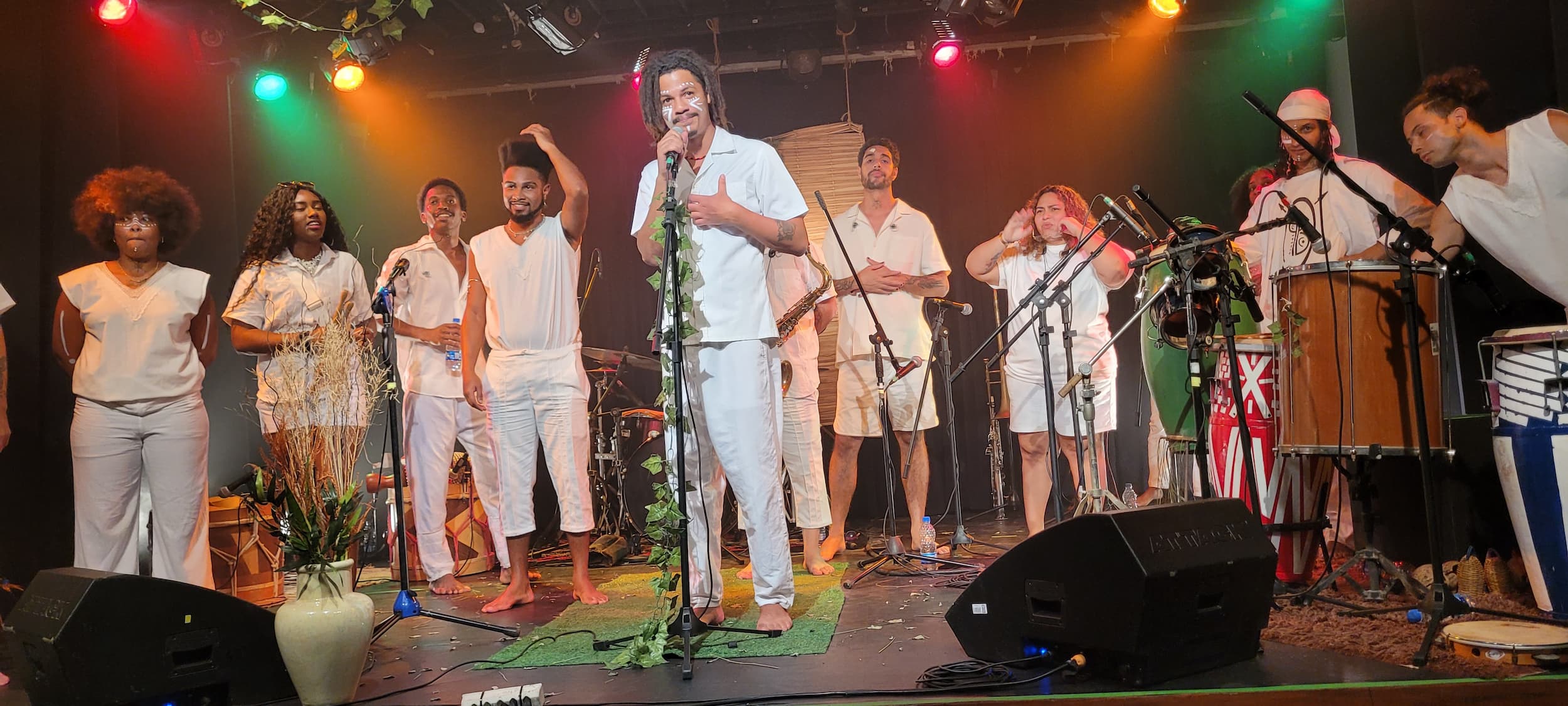
Victor Bruno: We have 13 musicians: drums, two alfaias, three percussionists (atabaques and effects), guitar, bass, and five horn players (trombone, two trumpets, two saxophones). Besides that, we have production, photography, legal, accounting, artistic direction, and sound teams. For larger performances, we mobilize up to 28 people.
Coluna da Neuza: What is the Orkestra’s impact on the region?
Victor Bruno: It’s huge. Barracão brings music and culture to people who often never had that opportunity. We started with street performances.. Today, we have support from cultural networks like the Museu Vivo do São Bento and we are recognized in the Baixada cultural scene.
A space for self-discovery
Ana Flávia Quitete, saxophonist and administrative coordinator of OPB, says her first contact with music happened thanks to the project:
“I joined the Orkestra in April 2018. I started helping with the administration alongside Bruno and then started playing the saxophone. I only got access to an instrument when I joined another project outside the Baixada. Barracão serves as that kind of bridge for many people in the community.”
The organization also acts as a space for self-discovery for its members, as percussionist Jefferson Borges shares:
“I first came to help with the studio construction and fell in love with the atabaque. I started attending the ceremonies at the terreiro next door and was invited to join the band. Today, music is my refuge and my pride. Recently, we did a tour with SESC. Since joining the Orkestra, it’s been all about growth.”
Vocalist and percussionist Yasmin Matias shares the same sentiment:
“Bruno invited me right at the start. I had just lost my grandfather, and the band helped me not fall into depression. Today, I play the alfaia, xequerê, and also sing. Barracão has become a family for me—a space of support, healing, and resistance.”
Musician Thaísa Fernandes highlights the pride she feels in being part of the initiative:
“I joined in 2023 for a one-time project and ended up staying. I had participated in other projects, but the Orkestra is unique. Today, it’s my main job. The mix of rhythms, people, and stories makes everything very special, especially because it’s happening in the Baixada, where this is rare.”
Finally, bassist and musical director Castrin emphasizes that the methodology used is one of the project’s key strengths:
“The combination of musical languages that come from the Baixada’s lived experience is what gives us this uniqueness. Here, you learn music in practice, with passion. That’s what makes the Orkestra’s sound so unique—more than just technique, it’s soul. We’re different because we carry a story of resilience and love for music.”
Did you enjoy this project?
Follow them on Instagram and help spread the word: like, share, and amplify the message!