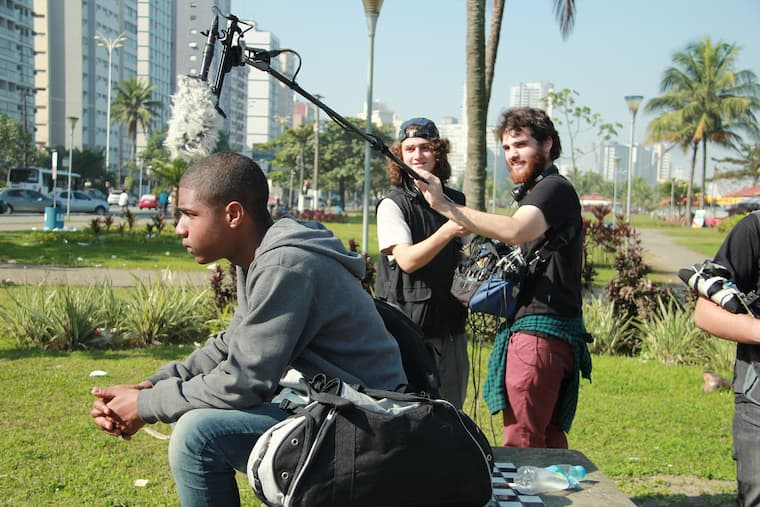
Instituto Querô workshops have impacted over 12,000 young people; the NGO has sent talent to some of Brazil’s top audiovisual production companies
Born in the port region of Santos, the writer Plínio Marcos is globally recognized for his marginal literature. He authored the novel Querô, uma reportagem maldita (“Querô: A Damned Report”, in English), published in 1976 and adapted for film in 2007. The story follows Querô, the son of a dockside sex worker who dies after drinking kerosene when he is still a baby – hence his name.
Instituto Querô inherited the film’s name but bears no resemblance to the tragic story of its protagonist. Quite the opposite. The initiative has been creating opportunities for hundreds of young people in Baixada Santista. Founded in 2006, the institute offers filmmaking and audiovisual training workshops for public school students in Santos, São Vicente, Cubatão and Praia Grande, on the southern coast of São Paulo.
It all began in 2004 when the film’s director, Carlos Cortez, decided to shoot the feature using non-professional actors. To do so, the production company Gullane Entretenimento partnered with Cortez to scout talent in the favelas of Baixada Santista. Out of 1,200 auditions, 40 young people were selected and trained to act in the film.
“When it was over, we had all these incredibly talented kids wanting more. So, we created a project with UNICEF to help them become audiovisual creators, because their chances of employment would be greater”, recalls Tammy Weiss, coordinator and one of the founders of Instituto Querô.
And so, year after year, Querô’s tragic narrative is replaced by talented boys and girls walking red carpets, seeing their films on streaming platforms and working with national and international production companies. “One of the young people trained in our Querô Workshops worked on the production of the film I’m Still Here”, Tammy says proudly.
Youth and the film industry
In nearly 20 years of activity, Instituto Querô has produced around 500 films, delivered cinema workshops to almost 12,000 public school students, trained 630 young people in audiovisual skills and referred more than 1,300 professionals to jobs in the film industry. As a result, it has collected 120 awards over the years. Sócrates and Andor, the latest feature films produced by Querô Filmes, have screened at national and international film festivals.
In a country that often undervalues its own film industry, these numbers are a sign of hope. In Brazil, audiovisual policy changes with each new administration, making consistent film production a persistent challenge.
“Brazilian cinema is, perhaps, one of the most affected artistic sectors when it comes to constant disruptions in public programs and policies over the years. Whenever one administration starts to build progress, another comes in and changes everything. It’s a cycle of constant restarts for Brazilian film,” Tammy explains.
Still, the cinema industry has enormous potential, she continues. “When a city has its own Film Commission, it not only strengthens the audiovisual sector but also boosts tourism and stimulates the local economy. Cinema generates jobs, preserves culture, and builds memory – it’s the history of a people. It’s how we show the world our country, our lives, and our culture”.
Stories that impact
Anyone who works in film knows the power of storytelling – and for young people, it’s a space filled with endless possibilities. According to Tammy, the transformation brought about by audiovisual creation is evident. “It’s not just about making films, telling their stories, and speaking about their communities. It’s also about self-definition, about becoming who you are”.
She emphasizes that the institute’s team brainstorms and pitches story ideas, but it’s the young people themselves who choose the narratives they want to tell. “Often, they speak about issues that are urgent within their communities, yet the stories remain diverse. There are anti-racist films, political pieces, and protest-themed work, but there are also many lighthearted and joyful stories”, she explains.
“Our films often feature Black, LGBTQIAPN+ actors and actresses, with women and trans youth involved in production, screenwriting, and directing. We aim for representation and actively work within the framework of affirmative policies”.
Cinema in Baixada Santista
All of Querô Institute’s projects are made possible through the support of partners. Tammy makes it clear: those who fund Querô are not just offering financial support, they’re joining a cause. “We build things together. We share the challenges and also celebrate the successes,” she says.
To support this, the institute has built a highly effective communications team, handling videos, social media and other materials. According to Tammy, this strengthens the project and fosters long-term partnerships. The institutional department has also grown in recent years, enabling the organization to apply for grants, secure funding, establish agreements and pursue public funding through parliamentary amendments.
The result is worthy of a red carpet. Films produced by Instituto Querô usually premiere at Cine Roxy, the largest street cinema in Santos. With nearly 500 seats, many of the young filmmakers attend their big premiere in formalwear.
“They show up in full glam, their names rolling in the credits – it’s wild! By the time they reach that moment, they’ve already transformed. And the following year, those who decide to pursue a career continue with training and get direct exposure to cinema professionals. After that, there’s no stopping them – they’re ready to break down every barrier”, Tammy beams.
Support this cause!
All films produced by the institute are available for free on Querô Play, democratizing access to cinema.
To learn more about Instituto Querô, visit their website and follow them on Instagram.