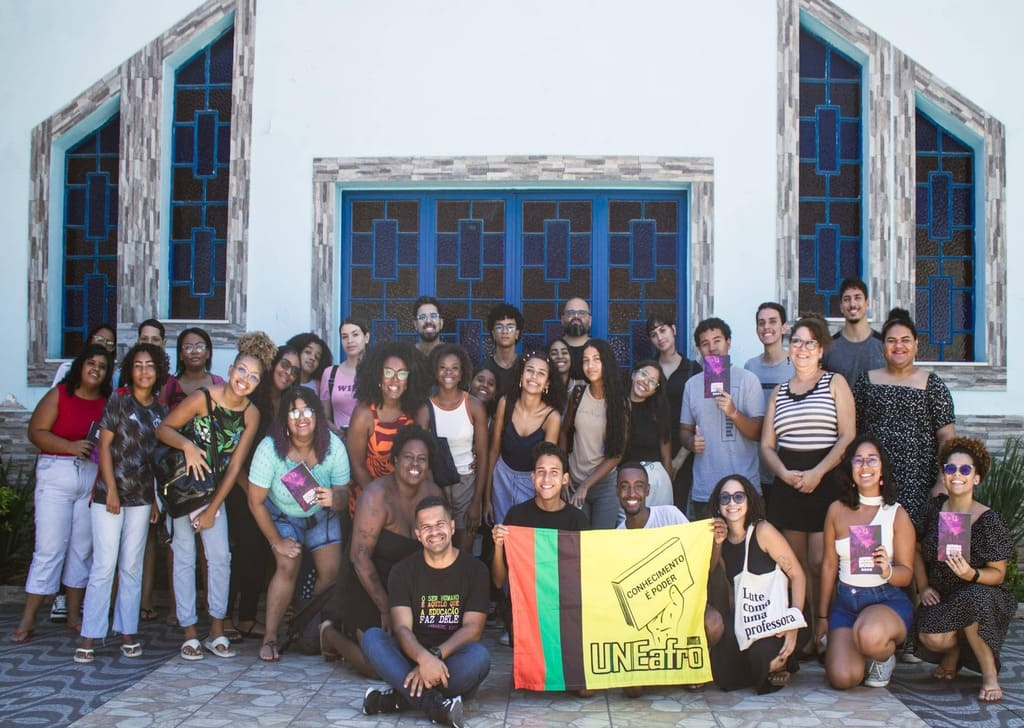
From prep courses to citizenship training, young people lead popular education projects to guarantee rights
With contributions from Aline Louzano, Neuza Nascimento, Julia Paresque and Fabiana Rosa
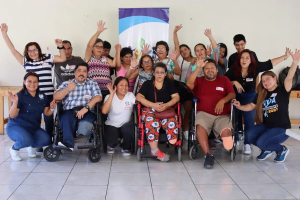
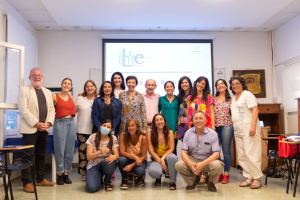
In 2019, a group of young people from the Maré Complex founded Seja Democracia (“Be Democracy”, in English), a free political training course with progressive ideals. That same year, in the same territory — known as one of the largest clusters of favelas in Rio de Janeiro, with 17 communities and 170,000 inhabitants — another young resident created UniFavela, a popular college entrance exam prep course that, in addition to offering preparatory classes for access to higher education, also serves as a center for social mobilization.
Beyond betting on popular education as the main path to defend rights, these projects share the fact that they are led by young people who openly identify as Black, from the periphery and university students. The moment in which they emerged was also no mere coincidence: Brazil had just elected a far-right president who declared that the system of racial quotas “reinforced prejudice”.
This system had been ensuring that young people like them would become the first generation in their families to enter public, tuition-free universities. Even so, similar narratives — based on the liberal logic of thinking about life in society — began to echo within the favela, in one of the most unequal countries in the world.
A study conducted in 2025 by economists Frederico Nascimento Dutra, Priscila Kaiser Monteiro and Sérgio Gobetti showed that about one-quarter of national income is in the hands of just 1% of the population. The survey also revealed that the wealthiest 20% of Brazilians hold 60% of national income.
“The far-right candidates announced that they would solve the issue of public security, employment and income. These so-called conservative and authoritarian discourses were trying to persuade people with promises of basic rights. We can’t assume that people voted for these candidates because they are ignorant”, recalls geography teacher and Seja Democracia coordinator, Cleber Ribeiro.
It was in this context that the youth who benefited from inclusion policies decided to roll up their sleeves and give back to society what had been most valuable to them: access to knowledge. With the far right rising to power, it was not only the integrity of democracy that was at stake, but also the inclusion of thousands of young people in the process of transforming society.
“Most of the students who come to our prep course still struggle to recognize themselves racially. This is concerning, because the quota system is one of the main mechanisms for accessing higher education and many young people don’t even know they have this right”, warns teacher and UniFavela founder, Laerte Breno.
More than a popular prep course aimed at access to higher education, UniFavela seeks to form young people with civic awareness and democratic participation. “The role of the institution is to shape attentive, critical and well-informed students, not only for exams but for civic life. Our pedagogical perspective works a lot on the ‘self,’ in the sense of becoming aware of oneself and recognizing the person under ethical, racial, gender and especially territorial aspects”.
The Current Affairs class, for instance, discusses local, national and international impacts. “It doesn’t necessarily appear on the ENEM exam*, but it is essential for students to understand the dynamics of the world and recognize their own importance within it”, explains the teacher.
To motivate students, the institution adopts strategies to fight dropout rates — for example, single mothers receive a solidarity scholarship. In addition, it promotes reading circles and other social activities that connect what was learned in the classroom with life in the territory itself. “When we create real conditions for permanence, such as individual monitoring, attentive listening, and financial support, we see that the effort pays off”, Laerte proudly says.
*ENEM is Brazil’s national high school exam, widely used as the main gateway to public universities.
Producing utopias
Years later, in 2025, the book The Impact of Quotas: Two Decades of Affirmative Action in Brazilian Higher Education, organized by sociologists Luiz Augusto Campos and Márcia Lima, showed that the quota system considerably increased the enrollment of Black, mixed-race and Indigenous students in the country’s universities: from 31.5% in 2001 to 52.4% in 2021. During the same period, the presence of students from classes D and E also jumped from 20% to 52%, showing that the change was indeed necessary to reduce inequality in access to higher education.
It is precisely with this generation that Seja Democracia works. Its training courses address topics such as racism, patriarchy, patrimonialism and intersectionality. The goal is to reflect on these concepts and, from there, build paths for collective action in the defense of rights.
“Since the protests of June 2013, we began to look at the history of grassroots mobilization in Brazil, and when Bolsonaro was elected president, we understood it was important to resume that movement. But to resume it under the new foundations of the 21st century, which involve technology and information”, says teacher and coordinator Cléber Ribeiro.
The results have been promising. The center has already mobilized 60 groups of young people across the country, through an online platform and a support network of local teachers. The most recent project boosted community newspapers and magazines in urban outskirts of Rio de Janeiro and Belém. With COP30 approaching, the debate on climate change has become a central topic.
The teacher celebrates: in addition to connecting the local population with urgent issues from their own perspective, the publications strengthen the territory by enabling the entry of newly graduated youth into the job market — all of them were paid through scholarships from the Heinrich Böll Foundation.
Finally, the recognition by the local population of the news production process legitimizes the information. “The newspaper is increasingly able to bring inputs regarding what the territory needs, and this individually guides who to vote for in the next elections. This awareness is fundamental for action”, observes Cleber.
For the teacher, representative democracy is going through a crisis due to its “inability to respond to the demands of the majority of the population, who today live in urban peripheries”. At the same time, young people in these territories “are increasingly eager for new arrangements, more participatory ones, to solve everyday issues”.
Seja Democracia therefore seeks to place the periphery at the center of the struggle for the rights of a diverse population that has historically never been in power. “This group, which is made up of the majority, should be able to be part of the State, to actively participate in its organization and in the construction of public policies. There is a great need for new logics, new forms of organizing social space, and this can emerge from the peripheries. So this is more of a movement of producing utopias”, he emphasizes.
The initiative thus proposes the very transformation of the Democratic Rule of Law. “Following the 1988 Constitution, the State can very well advance without Black bodies, without women in power. But we need means to equalize income distribution, in a way that is not consumed by the capitalist logic of wealth accumulation tied to environmental degradation. The territory cannot be seen only as a commodity”, argues Cleber.
Engaged youth
Not far from there, in the outskirts of Rio’s metropolitan area, Eisla Vycent, a young woman from Parada Morabi, Duque de Caxias, leads the Resgatando a Cidadania (“Rescuing Citizenship”, in English) project at the Mané Garrincha Full-Time School in Magé. Through historical research on the population of Magé and Duque de Caxias, Eisla mobilizes local youth. “I believe that through this knowledge, the perception of reality expands”, she says.
Her activism began early, at age 11, in her school’s student union. “At the time, there wasn’t this kind of political engagement, nor an understanding of the role of youth in Brazilian politics, at school and in the community. The student union began to recover this awareness, highlighting the importance of voting, taking a stand and fighting for rights”, she recalls.
The sociology student at Fluminense Federal University (UFF) also went through Seja Democracia’s training program and follows the path of this engaged generation. “In the territory where I worked, many young people didn’t even have documentation and, in my view, civic and democratic participation starts there. Without documents, a person becomes invisible”.
To this day, the student association remains her preferred form of activism, where she promotes conversations about “the true role of youth, the importance of social movements, and how student representation was fundamental during the military dictatorship”. Beyond that, she also relies on social media to reach people outside her territory, sharing content on citizenship and politics.
Eisla also created a collective at UFF to debate race and quotas — she was admitted to the university in first place through this system. “I often spark discussions with questions about the importance of quotas and why there is so much misinformation that leads young Black and peripheral youth to reject this right”.
For her, the policy that most fails in the periphery is education, with a lack of public spaces such as councils and forums to think about the rights of children, adolescents and youth. “The periphery has enormous potential, but it lacks information and self-recognition. In places like Duque de Caxias, many times the periphery doesn’t even see itself as such, and this limits the building of a stronger democratic foundation”, she explains.
On the role of youth in defending democracy, she notes that there are still many difficulties in accessing and understanding democratic power. “The pandemic and political polarization worsened this. Even when we gain access to spaces historically denied to us, we face silencing and invisibility”.
“I learned from Sueli Carneiro, in the book Dispositivo de Racialidade (“Raciality Device”, in English), that this process is structural: it makes Black and peripheral youth believe that such spaces do not belong to them. This explains why many do not take a stand, even in environments where they have the right to a voice. Being young, Black, from the periphery, a university student, a woman, or LGBT in Brazil is still a huge challenge. The social structure defines who has visibility and who is silenced. Breaking with this is a difficult but necessary construction, and I remain in this struggle”, she says.
Educating for Democracy
Today there are several popular education initiatives in the favelas and outskirts of Rio de Janeiro. A mapping carried out by Tecendo Diálogos (“Weaving Dialogues”, in English), a social cooperation project by Fiocruz in partnership with the Fórum de Pré-Vestibulares Populares do Rio de Janeiro and Fórum Favela Universidade, identified 300 community prep courses in the capital and metropolitan region.
The mapping involved ten researchers, who went into the field between 2021 and 2023 to gather socioeconomic information about these spaces. Of all the prep courses mapped, 130 responded to the questionnaire. This was the prerequisite for having their location identified on the ViconSaga platform, where georeferenced searches can be conducted.
In the midst of this mapping process, the Fórum de Prés presented the data to State Representative Dani Monteiro (PSOL), contributing to the drafting of State Law No. 9,548, sanctioned in 2022. The law established the incentive program for social, popular, and community prep courses in Rio de Janeiro and was welcomed as a major victory by both students and teachers.
“The majority of popular prep courses (PVPs) are housed in donated properties, which puts them in a vulnerable position. So the law strengthens popular education by stipulating that state schools must open their doors to these initiatives. At this moment, the law is still in the implementation phase, depending on the management of each school and the state department of education. Some are already inside schools, others are not. Even so, its existence is a major step forward”, notes professor and coordinator of the Tecendo Diálogos project, Taisa Falcão.
For her, PVPs have increasingly taken on a role of social responsibility by encouraging students and teachers to observe the demands of their territories and think of solutions through public policies. “With this, PVPs end up contesting the very model of society, in the struggle for social justice. This relates to the way science is produced at the university, transformed by the entry of peripheral bodies, but also to the transformation of society as a whole”.
That is why, Taisa emphasizes, many PVPs foster critical thinking in students while also preparing them for university entrance exams. “We must reflect on the society we live in today, which is extremely unequal, because otherwise they will enter university and quickly be co-opted by the logic of individualism and meritocracy. This is not beneficial either for the territories they come from or for society as a collective”, she says.
“It’s not enough to enter university, it’s necessary to stay and return”
The Bom Pastor popular prep course, in Belford Roxo, Baixada Fluminense, is part of this movement. The initiative began in 2017, shortly before Seja Democracia and UniFavela, but follows the same social dynamic. Coordinator Cássios Clay, 23, is a pedagogy student at the Rio de Janeiro State University (UERJ). He was elected Municipal Councilor for Racial Equality in 2022 and acts as an activist for Education and Youth in Baixada Fluminense.
According to him, “it’s not enough to enter university, it’s necessary to stay in it, graduate and return to strengthen the territory”, indicating that initiatives like Bom Pastor democratize knowledge and drive local development. “We don’t limit ourselves to academic preparation; we also promote access to culture and leisure, with guided visits to the Heritage Circuit, African Heritage and Aldeia Maracanã, among other spaces”, explains Cássios.
With this, the prep course seeks to raise young people’s awareness of rights and deprivations. “Here, young people grow up without access to leisure, quality education, sanitation, security and housing. How can they be the future of society under these conditions? I managed to get here, but I think about those who can’t. Bom Pastor is the youth’s organized response to the absence of the State. It is urgent to look at Baixada, at Black and peripheral youth”, he demands.
To break this stigma, Bom Pastor encourages students to participate in municipal councils, public hearings, popular education seminars and other spaces where democracy is built. “These activities make young people understand that citizenship must be exercised in practice, by occupying decision-making spaces”.
The prep course also supports students in defending their rights, turning information into opportunity. Students come to know they are entitled to the Student Retention Grant, Youth ID, scholarships at public universities and internships in public agencies: opportunities that can change trajectories. “They become aware of the paths they can take for their personal and professional development”, points out the coordinator.
Living Well
Bom Pastor is the result of a partnership between UNEAFRO Brasil, the Interdisciplinary Center for Social Development of the Federal University of Rio de Janeiro (NIDES/UFRJ), and the Fórum Grita Baixada, historically recognized grassroots organizations. The Fórum Grita Baixada, in particular, is the product of local social mobilization to confront violence. Over time, it came to strengthen the movement for the defense of democracy. “It is fundamental to guarantee a safer city”, says coordinator Adriano Araújo.
The most veteran among the projects mentioned, Fórum Grita Baixada emerged in 2012 to shed light on the harsh reality of Baixada Fluminense, where the deaths of young Black and Brown people are often ignored by mainstream media. According to the Instituto Fogo Cruzado, one in three people shot in Greater Rio are from Baixada, considered one of the most populous peripheral regions in Brazil, with 3.6 million inhabitants.
“People who once did not feel valued in their activism now find a space in the Fórum. Mothers who lost their children to murder are invited by the Ministry of Justice and the Ministry of Racial Equality to share their stories”, says Adriano. “The Fórum has managed to make these dynamics more visible. Some family members have reported that they feel more respected in their struggle”, he continues.
Violence generated by conflicts between criminal factions and police clashes is a constant concern for popular education initiatives in Rio’s territories — only in July 2025, 222 shootings were recorded across the metropolitan region and the capital, according to the Instituto Fogo Cruzado.
All the leaders interviewed for this report agree that to make democracy effective in peripheral territories, it is first necessary to generate social and economic well-being by strengthening access to rights such as health, education, decent work and public security. Democracy, therefore, is not seen merely as a political system, but as a structure that enables good living.
For a long time, scholars such as Paulo Freire, Anísio Teixeira and Maria Victoria de Mesquita Benevides have pointed out that the absence of civic education reinforces inequalities, fosters injustice, and can lead to true segregation. The rise in violence could thus be considered the first symptom of authoritarian and anti-democratic societies. On the other hand, popular education — understood as an education of all for the common life—is the main instrument of democracy.
The coordinator of Fórum Grita Baixada sees this in practice. “Since violence is a complex phenomenon that involves education, work, employment, income, racism and a series of aspects, we began working with these issues through popular education”, Adriano comments. The organization conducts political training, denounces undemocratic public administrations and organizes marches and public hearings.
“We seek to transform representative democracy into a more direct and inclusive experience for the population. We have a major discussion about the responsibility of public managers. Often, we are called upon to lead debates during election periods, to think about projects for the city, the city we want, as well as citizens’ participation in public life”, he explains.
Adriano notes that the growth of right-wing and far-right discourses in the periphery occurs in moments of economic and social crisis. “Slogans like ‘a good criminal is a dead criminal’ are even adopted by the popular classes, who are often victims of violence”, he warns. At the same time, he has observed a growing interest among young people in the cultural and artistic projects offered by the Fórum.
“Adhesion is still low, due to the precariousness and instability of youth life, marked by unemployment and family conflicts”, he points out. Even so, he bets on these initiatives to encourage young people to “put pressure on governments so that they truly represent the interests of the population”.
There is no doubt that the role of youth is central to this process. As Bom Pastor PVP coordinator Cássios Clay said: “Young people have this power to dream of a fairer world and to inspire others to act. They are able to communicate, mobilize and engage, not only through voting but also by spreading awareness of rights. This can be done on TikTok, Instagram and WhatsApp, as well as in slam poetry circles, in rap, on stages and in public squares”.
*The article contacted the Public Prosecutor’s Office and the Public Defender’s Office of Rio de Janeiro to learn what measures are being taken to confront the violence plaguing the state and harming youth, as well as what actions these institutions have for the defense of democracy. So far, we have not received responses. If the institutions comment, this text will be updated.