Founded in 2012, the organization has already reached more than 5,000 families across Brazil and now works in partnership with hospitals, schools and healthcare professionals.
The death of a child is often described as one of the most devastating experiences a family can endure. In Brazil, however, structured initiatives to provide psychological and social support for grieving parents remain scarce. It was within this gap that Amada Helena was created in Porto Alegre (RS) in 2012, founded by Tatiana Maffini.
Tatiana’s first daughter, Helena, was born with a heart murmur and died at just 17 days old while waiting for a neonatal ICU bed. “It was incredibly difficult for me and my husband. We had been married for 15 years, we communicated well, but after this loss we couldn’t talk anymore. The silence around grief is subtle, families avoid the subject as if not mentioning it would ease the pain. But we need to talk about it,” she recalls.
What began as a campaign for more neonatal ICU beds evolved into a national benchmark in parental grief support. Today, the NGO has assisted more than 5,000 families across the country. “Through contact with other families, we realized this wasn’t just our pain, it was a social issue,” Tatiana says.
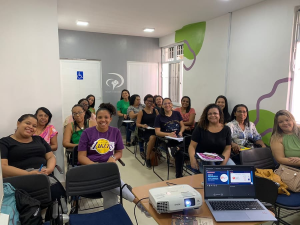
The organization’s mission is to create safe spaces for listening, sharing, and emotional resilience. To achieve this, it runs support groups, works alongside healthcare and education professionals, and promotes awareness campaigns to break the taboo around parental grief. “The goal isn’t to eliminate pain, but to help families live with it and rebuild their social bonds,” Tatiana explains.
National impact
Although headquartered in Porto Alegre, the NGO has expanded its reach through both in-person and online meetings, making its support accessible nationwide. Sessions are moderated by volunteer psychologists who have also experienced loss, strengthening the trust between families and facilitators.
In the past year alone, the organization conducted 900 direct support sessions. It has also published an informational guide, now in its ninth edition, and contributed to state-level legislation protecting the rights of grieving families in Rio Grande do Sul. “Talking to professionals in health and education, we realized this work had to go beyond support groups. It needed to become a social cause,” Tatiana says.
This advocacy has resulted in two state laws: Law 15.313/2019 and Law 15.895/2022 — the latter known as the Helena Maffini Law. On a national scale, the approval of Federal Law 15.139/2025, establishing the National Policy on Humanized Support for Maternal and Parental Grief, was also celebrated, even though Amada Helena was not directly involved in drafting it. “We welcomed the federal law, but some gaps remain. It should have included mandatory identification wristbands for bereaved parents in hospitals and awareness campaigns for healthcare professionals,” she notes.
Information as prevention
For Tatiana, respecting the pain of grieving families without stigmatization is crucial. “This is a historically silenced issue in Brazil. When we lost Helena, there was no collective knowledge about parental grief, only isolated personal accounts. That made recovery harder,” she recalls.
“Talking about grief honestly, without romanticizing it, ensures that families are supported, and that lives can be saved. Our mission is to make sure public policies truly reach those who need them,” she says.
She stresses that prenatal campaigns and access to medical information are key in preventing avoidable losses. Conditions such as thrombophilia and eclampsia, for example, are still rarely discussed with the public. A promising step is that, starting August 26 this year, Brazil’s new federal policy will include expanded prenatal testing for pregnant women.
“Many mothers only learn of these conditions after two or three pregnancy losses. Information can save lives, but it doesn’t always reach families,” Tatiana warns. Another persistent challenge, she adds, is the shortage of neonatal ICU beds in many regions. “This is not a family’s choice. It’s a structural issue that must be addressed.”
Parental grief
Tatiana points out that many mothers experience guilt, reinforced by subtle questions about prenatal care, diet, or childbirth. “No one says directly, ‘you are to blame,’ but the insinuations carry that message,” she says. Fathers, she adds, often become invisible in this process, even though they grieve just as deeply. “Women have a physical and hormonal connection with pregnancy and postpartum, but men also go through a profound mourning process. We need to look at both.”
Thirteen years after Helena’s death, Tatiana says the pain never fully goes away. “There are very difficult days. We’re never the same after losing a child. It’s a rupture in life. But we need to keep going,” she says, moved.
Support this cause!
Learn more about Amada Helena on the organization’s website, and follow its work on Instagram and Facebook.