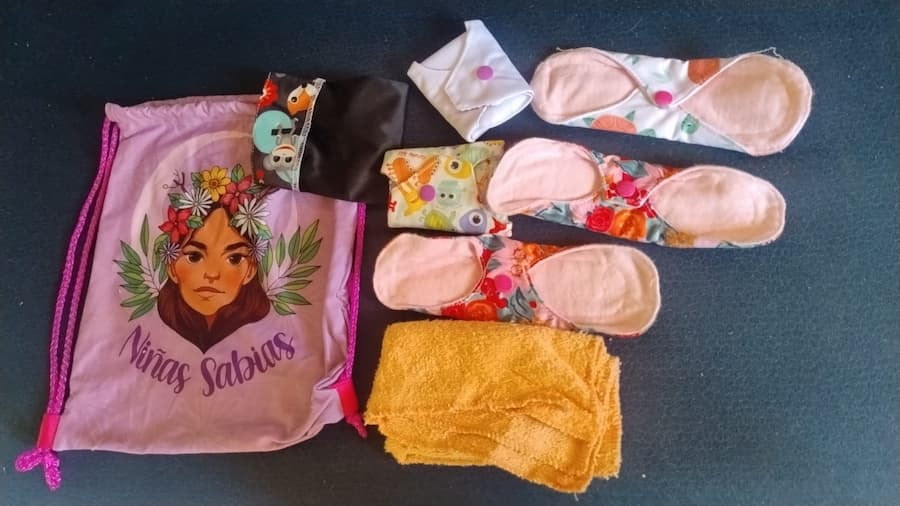
The kits include: two overnight pads and three regular pads, a liner, a hand towel and a waterproof bag for changing pads
The Curré Indigenous Territory is located in the canton of Buenos Aires, in the province of Puntarenas, Costa Rica. From there, a project is being developed that aims to change the mindset of low-income girls and young people regarding menstrual health.
Incâ, which means ‘menstruation’ in the indigenous Brunca language, is a non-profit organisation born out of the need to work together to ensure that girls from low-income backgrounds have access to feminine hygiene products, precisely because their socio-economic circumstances do not allow them to cover this monthly expense. This is compounded by a reality rife with myths and beliefs about menstruation, not only within the indigenous community but across different parts of the country.
Although its work focuses on producing reusable kits, the NGO is committed to dispelling one of the main myths: that menstruation is dirty, bad and even a form of ‘divine punishment’, as minors have told them due to a lack of knowledge and education. This is how María Imelda Lázaro, founder of Incâ, puts it.
“Attitudes towards menstruation are generational. We grew up with the mistaken idea that our own blood is dirty or bad, and this has become ingrained right up to the present day, when in reality it is completely natural and part of female development. It is painful to see how girls feel ashamed and are unable to talk about the subject, a phenomenon that is more visible in vulnerable communities and those living in extreme poverty, mainly due to the upbringing they have received within their families and the way the women around them were raised,” adds Lázaro.
According to the NGO’s own estimates, since its foundation in 2022, more than 5,000 sanitary towels have been produced for distribution in the community of Curré and surrounding areas, as well as in other provinces of Costa Rica; the latter thanks to partnerships established with other NGOs and charitable organisations. In fact, Incâ has established a collaborative partnership with Voces Nuestras, an organisation focused on human rights, which in turn connected it with the Niñas Sabias project, which works to eliminate the stigma surrounding menstruation in Mexico and Costa Rica.
Promoting feminine hygiene and menstrual health
According to estimates by the UN and UNICEF, more than 2 billion people worldwide menstruate every month; however, millions of women and girls do not have access to menstrual products or safe water and sanitation to manage their feminine health and hygiene.
These kits aim to promote feminine hygiene from an early age: fewer infections caused by the materials in commercial sanitary towels, prevention of unpleasant odours and, for those on low incomes, financial savings. “We must educate and raise awareness among young girls about their menstrual health and empower them to take control of their bodies, which will bring them many long-term benefits,” adds Lázaro.
Incâ’s work is quite meticulous, from selecting hypoallergenic fabrics to the waterproof lining (known as PUL), which must be of high quality to prevent leaks or seepage. Once the materials are on hand, the towels are made and undergo quality checks to ensure they work properly.
The waterproof layer used in the pads is imported from the United States and is expensive, so the NGO has to organise fundraising activities; however, they have received help from private organisations that assist in sourcing the material.
Estimates from the UN Environment Programme indicate that, on average, women who use sanitary towels generate 60kg of waste from this product during their lifetime, which equates to 100,000 tonnes of waste per year.
Economic and commercial challenges
When demand for period kits is high, Incâ hires more seamstresses to keep up with orders, thereby helping to boost the incomes of women in Curré; however, this support is only available for the duration of the manufacturing process.
“When we have a very large order, we call on more seamstresses from the community and pay them for their work. This payment comes from the funds we raise through our own activities, donations and commissions, but there comes a point when production ends and the NGO’s support runs out,” explains the founder of Incâ.
Apart from the waterproof fabric, which is the most expensive component, there is the challenge of marketing the product, due to a general lack of awareness among people who still think that reusable towels are dirty or do not serve the same purpose as commercial ones. Digital platforms such as WhatsApp and social media are used to promote the kits; word of mouth among neighbours in nearby communities and orders from organisations such as Niñas Sabias also play a part.
How can you help?
Incâ does not receive regular donations nor does it have full-time staff, so it organises fundraising activities; however, the organisation believes that change is possible thanks to the solidarity and commitment of individuals and businesses. “We are calling on all individuals and organisations who can help us reach more parts of Costa Rica.”
For further information, please contact us by email at marialazaroe@gmail.com, via WhatsApp on +506 8854 7917, or on Facebook.