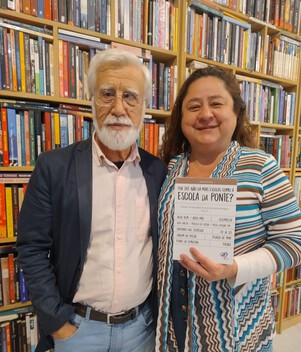
Teacher, actress and theater director Janaína Chichorro created a project inspired by the practices of José Pacheco, founder of the Escola da Ponte in Portugal
Located within the Parque Estadual Itaberaba (Itaberaba State Park), Ecovila Aldeia Moarandu is a 20,000-square-meter space near the Nazaré Paulista reservoir, in the countryside of São Paulo. It is home to teacher, actress, and theater director Janaína Chichorro, a reference in the innovative pedagogical practices of Portuguese educator José Pacheco.
Janaína was responsible for transforming the Escola Estadual Professor Rosende (Professor Rosende State School) in the nearby town of Bom Jesus dos Perdões. When she arrived, the institution was among the lowest-rated in the state, with exhausted teachers and unmotivated students. “The principal at the time had attended a lecture by Pacheco, where he challenged the audience, saying that if there was still someone ‘alive’ at a school, they should call him. And the principal did,” she recalls.
Invited by Pacheco and inspired by Paulo Freire, Maria Nilde, and Ana Mae Barbosa, she created the Projeto Rosende Escola de Portas Abertas – Proepa (Rosende Open Doors School Project) alongside a team of eight teachers, one from each sixth-grade subject. “They believed in the idea. We would meet voluntarily on Saturdays to plan, exchange ideas and understand the challenges faced by each student group. It was an artisanal kind of work, carried out with affection and purpose.”
Since then, Moarandu has become a hub for art and education in the region, hosting workshops and experiences on folk culture, pedagogical practices, agroecology and sustainable living. “This is the place where these practices can truly thrive. We are even working to transform this space into a rural school, in accordance with the Brazilian National Education Guidelines and Framework Law”, she emphasizes.
A school made of people
Implemented between 2017 and 2020, Proepa was recognized by the Diretoria de Ensino de São Paulo (São Paulo Department of Education) for its innovative practices. The project began with two sixth-grade classes, around 70 children, and concluded when they finished the ninth grade, the final year of middle school.
The first decision was bold: to keep the classroom doors always open. Students received a daily schedule, before and after recess, outlining the activities they were expected to complete, the spaces where they could work at, and the teachers they would learn with. There was freedom, but also responsibility.
“They could study Portuguese in the woods, build a 3D food pyramid in art class or research consumption charts in geography. Learning happened in an integrated way, connecting different subjects to real-life themes,” says the educator.
The project also encouraged student leadership. There were groups responsible for cleaning, organizing materials and answering peers’ questions. Lectures were not mandatory and could only be scheduled when students themselves felt the need to better understand a topic.
“It was funny to see the classroom fill up for a lesson on square roots,” she recalls, laughing. “They asked for [that class] because they wanted to understand the subject. Learning came from curiosity, not obligation.”
Education with purpose
José Pacheco became known worldwide after creating Escola da Ponte (Bridge School). His pedagogical practices seek to break away from the rigid routines of traditional schools through multidisciplinary learning paths, pedagogical mediation, and personalized tutoring. Family involvement is essential for this approach to succeed.
At Proepa, parents and guardians participated from the very beginning, signing a commitment agreement and following the entire process. “We presented the idea that it would be a gradual journey. Students would gain autonomy, and the school needed to be ready for that,” explains Janaína.
School assemblies also became an important tool for democratic coexistence. Students themselves proposed agendas, discussed conflicts, and created collective solutions. “They realized they had a voice, that they could shape the environment where they studied. The school became calmer, more alive. It was beautiful to see the respect and joy in the air.”
“This was the most authentic and transformative project I’ve ever experienced in public formal education,” the teacher sums up. “We saw that it’s possible to build a school where people want to be, where they want to learn and take care of one another. A living school,” she says proudly.
The encounter with José Pacheco
It was during her undergraduate studies in Literature, in the late 1990s, that Janaína Chichorro first came across the pedagogy of Portuguese educator José Pacheco. “I read The School I Always Dreamed Of Without Imagining It Could Exist, from Rubem Alves, and discovered that what I had always envisioned already existed.”
Reading soon turned into action. In 2004, she met Pacheco in person for the first time, when he was already living in Brazil and bringing together people from different regions to discuss new ways of teaching. From this movement emerged the group Românticos Conspiradores (Romantic Conspirators), a collective that organizes annual gatherings to reflect on Pacheco’s work, share experiences, and strengthen the process of educational transformation.
“Every time a principal says they want to change their school, Pacheco tells them there are teachers who want to make it happen. We go there, create experiences, and start moving things forward,” she says.
A teacher in São Paulo’s state school system since the early 2000s, Janaína, who is also an actress and theater director, is a true activist for education. With the support of José Pacheco himself, she adapted the book For the Children of the Children of Our Children, a collection of short stories inspired by school experiences, for the stage.
The result was a theatrical production featuring videomapping and an original script, presented at Sesc venues and various festivals. Later, she also directed a staged reading for the Sesc Art Circuit, based on the book Learning in Community, in which Pacheco writes letters to Brazilians who inspire him, from Paulo Freire to Nise da Silveira.
“I really wanted to bring the theme of education to the stage, because everyone says it’s a boring subject, that it doesn’t attract audiences. But a country that thinks that way can’t move forward. When I started researching Latin American theater, which gives actors more creative freedom, allowing them to take part in building the performance, I decided to create plays about Zé Pacheco,” she explains.
By uniting art and pedagogy, Janaína shows us that fostering emancipatory education is the greatest legacy one can leave. “It was at school, while I was still a student, that I experienced my best relationships and discovered theater. It was an art teacher who introduced me to this world. She asked us to express our views on a plebiscite through art. That’s when I understood the power of creative learning,” the educator concludes.
Get to know Ecovila Aldeia Moarandu
In addition to offering in-person workshops and experiences at Ecovila Aldeia Moarandu, Janaína Chichorro also provides online training courses for educators, presenting José Pacheco’s pedagogical practices and guidance on how to implement similar projects.
For more information, follow the social media channels on Instagram.