For more than 20 years, the organization created by Alec Deane has been promoting educational, agricultural, and cultural projects alongside Indigenous communities in Salta. In one of the most neglected regions of the country, Fundación Siwok fosters access to water, food production, and community self-sufficiency
By Paula Galinsky
“With a very small investment, you can produce a lot,” summarizes Alec Deane, founder of Fundación Siwok, an organization that for more than two decades has been promoting rural education in Argentina, productive and social projects in indigenous communities in the province of Salta, in northern Argentina.
Alec is 69 years old and has devoted an entire lifetime to working with indigenous communities. An agricultural engineer by training, he left the family farm in Buenos Aires province to settle in the Salta’s Chaco region. “I grew up in the agricultural world, but I felt I had to put my knowledge at the service of those who needed it most,” he says.
This began a story that has now spanned 46 years alongside the Wichí, Chorote, and Toba communities, which took institutional form in 2002 with the creation of the Siwok NGO.
Since then, the foundation has become a fundamental support for families living in areas where access to water, education, and food remains a daily challenge.
“We work mainly in Salta, with communities living near the Pilcomayo and Bermejo rivers. These are departments with the highest levels of unmet basic needs in the country,” Alec explains.
Education and Local Development
The foundation aims to improve living conditions from a comprehensive approach, through programs that integrate rural education, access to water and sustainable agriculture. “The most serious problem is the low quality of education. This directly impacts malnutrition and infant mortality. Many children are promoted to the next grade without being evaluated,” he warns.
Faced with this reality, Siwok promotes educational gardens in 45 rural schools, where students learn to produce food, nurture the soil and apply sustainable techniques. The experience seeks not only to improve nutrition but also to strengthen the sense of community. “We teach them to produce food, to care for water, and to understand that working together can change things,” says Alec.
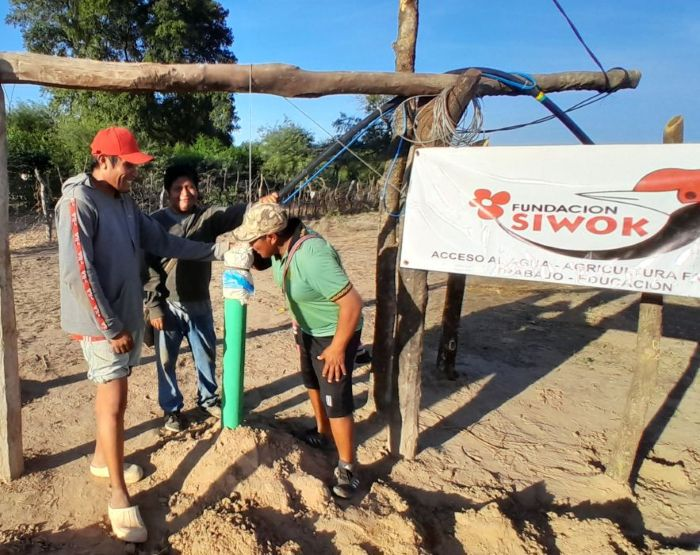
The organization also collaborates with the installation of water wells and drip irrigation systems. “We’ve already built more than 100 wells so families can access drinking water. With just $60, one can set up an irrigation system, plant good seeds and in 90 days earn up to 500 dollars”, he details.
Production and Autonomy
In the communities where the foundation works, the impact is visible. “Families grow corn, beans, and squash — the so-called ‘three sisters. Many achieve three harvests per year”, says Alec.
Additionally, Siwok promotes artisan production: woodcraft, instruments and paintings that preserve cultural traditions and serve as sources of income. “We also teach them to make violins and market them. The goal is for families to diversify their income sources”, he adds.
Despite being a small organization, the reach is significant. “We are directly serving about 5,000 children,” Alec specifies. The structure is sustained by a small team: three coordinators, ten trainers, and the support of local volunteers.
“We have help from the South American Missionary Society (SAMS) in Ireland and a few donors from Argentina, but we need more support to sustain the projects,” he acknowledges.
Antonio’s Story
45 kilometers from Embarcación, on Route 53, lives Antonio Gómez, a member of the Wichí community of Misión Chaqueña. He is 66 years old and has five children. “I started in 2011 with crafts. The foundation used to buy our woodcraft decorations, decorative items. Then I dared to improve my land work,” he recounts.
Through Siwok’s technical support, Antonio learned new irrigation and planting techniques related to sustainable agriculture. “Now we have tomatoes, corn, watermelon, lettuce, to eat and also to sell,” he notes.
He also received help with the construction of wells. “At first, we had to dig them ourselves, by hand. Later, the foundation provided drilling machines, allowing us to dig deeper”, Antonio relates.
In his community, meanwhile, they installed a greenhouse, which allowed them to expand production and secure food throughout the year. “With their help we were able to have water and learn to work the land differently,” says Antonio, who summarizes the project’s impact simply: “They taught us self-reliance, to produce for ourselves.”
Challenges and Requests
Alec acknowledges that the achievements are significant, but that there is still much to do. “We need the government to support this kind of work, to take the experiences and turn them into public policy”, he details.
At the same time, he insists that small private donations can make a big difference. With minimal contributions, the training center is maintained, seeds are purchased, or water wells are drilled.
His vision is clear: “We dream that every family can have its own garden, its own water source and the possibility of teaching their children that work is worthwhile.”
How to Help
Fundación Siwok has been working for more than twenty years in northern Argentina, supporting indigenous peoples of Salta through education, water, agriculture, and cultural programs. Those who wish to collaborate can do so with donations or by sponsoring specific projects. More information at siwok.org.