With 36 years of activity, the Associação de Atenção ao Deficiente Auditivo e Surdo develops a communication-centered approach, teaching Brazilian Sign Language (Libras) to deaf individuals, supporting families, and training professionals
The Associação de Atenção ao Deficiente Auditivo e Surdo – AADAS (Association for Assistance to the Hearing Impaired and Deaf) is a reference in supporting deaf children and their families in São José dos Campos, in the state of São Paulo. Founded in 1989 by five families who came together in search of specialized support for their children, the organization now serves more than 2,000 people every year.
“Everything started because there was no institution in the city that provided support for deaf children”, explains Adriana Gomes, project coordinator at AADAS. “These families joined forces and began a project focused on education. Over time, the association evolved and began working on social development and the autonomy of deaf individuals”.
Today, the main focus is the teaching of Libras, the Brazilian sign language, carried out by a multidisciplinary team. “Libras is the first language of deaf people. And because it is a visual-gestural language, the deaf person needs to look at someone directly to communicate. So it is different from oral language, which we learn indirectly from birth”, Adriana explains.
Visual language
Through a partnership with the local city government, AADAS receives individuals from 0 to 59 years of age, referred mainly by CREAS – Centro de Referência Especializado de Assistência Social (Specialized Reference Center for Social Assistance). Support takes place outside regular school hours and includes psychological, speech therapy, and educational counseling.
In addition to the deaf individual, their family members are also welcome so that everyone can learn Libras and communicate at home. “Here, we work with the entire family: father, mother, siblings, grandparents. Everyone needs to learn, because communication is the first bond of affection. And when communication fails, the bond also becomes fragile”, says Adriana.
One of the major challenges faced by the team is the process of recognizing deaf identity. “Many people arrive at AADAS without considering themselves deaf, even when medical reports show hearing impairment”.
“Deafness is not visible. Many people use hearing devices or hear partially and believe they are hearing individuals. When they arrive here, they discover that there is a language, a culture, a way of being. It is an awakening and it is emotional to witness”, she adds.
First signs
This awakening can begin very early. Babies as young as six months take part in the Meus Primeiros Sinais (My First Signs) program, created to help families learn how to play and communicate with their children. “While a hearing child learns to speak by listening to conversations around the house, a deaf child needs to see. Their communication is visual. So the family needs to stop, make eye contact, and speak with their hands”, explains Adriana.
Adriana becomes emotional when recalling moments in which families realize the power of visual communication. “There are parents who spend years without being able to truly communicate with their child. When they learn their first sign and understand each other, it is a true revolution in the household”.
She points out that the families seeking support at AADAS are diverse. Some have hearing parents and deaf children, while others have deaf parents and hearing children. “We have a family with a deaf mother and father, a deaf daughter, and two hearing children. It’s a beautiful reversal that shows how communication is at the center of everything”, says Adriana.
In such families, hearing children are known as CODA an English acronym meaning Children of Deaf Adults. They grow up in a bilingual environment and often end up acting as interpreters for their own parents. “That is a responsibility far too great for a child. For this reason, we also welcome these families and work from both sides”, she adds.
Deaf identity and autonomy
Adriana explains that many people arrive at the institution without mastery of any language, using only “home gestures” that are understood only within the family environment. “These gestures work at home, but not outside. When the child or teenager begins learning Libras, everything changes. Life takes off”.
One of the pillars of AADAS’ work is strengthening deaf identity, which recognizes deafness as a linguistic and cultural difference. “We work with a different form of communication, not with a defect. Deafness is not visible, and many people do not see themselves as deaf. Our role is to support this awakening”, she says.
“The family needs to be the first channel of communication. When this does not happen, the deaf child grows up with gaps, without understanding what is happening around them. That is why we teach parents to communicate with their children from an early age”, she adds.
Libras training
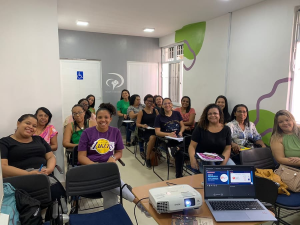
In addition to direct support for families, AADAS develops awareness and training initiatives for the hearing community. Among the projects, a Libras course taught by deaf teachers stands out. The program has already trained professionals from various fields, such as doctors, teachers, firefighters, and business owners, to promote inclusion in everyday life.
“We want deaf people to go to the doctor or the theater without depending on an interpreter. We want them to have autonomy and for people to know how to communicate with them. That is respect, that is citizenship”, Adriana emphasizes.
She also recalls that the institution revised its own acronym to explicitly include the word “deaf.” “The term ‘hearing impaired’ is clinical. Using the term ‘deaf’ reflects a social perspective. We are not talking about lack, but difference”.
“Our work is to provide attention, guidance, and the conditions for deaf people to achieve independence. We don’t do things for them, we walk alongside them, respecting their pace and their identity”, she concludes.
Support this cause!
For more information, follow the social media channels on Instagram, Facebook and TikTok.