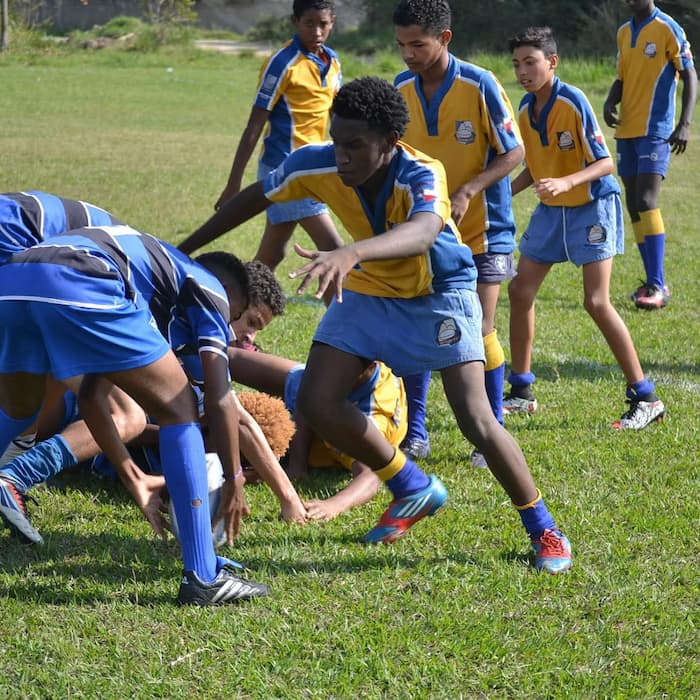
A rugby project that began informally on Ipanema Beach, in Rio de Janeiro, is now transforming the lives of children from Morro do Cantagalo through sport, human values, and education
Rugby is a sport created in 1823 in England, when student William Webb Ellis is said to have broken the rules of traditional football by running with the ball in his hands during a match at Rugby School, a traditional English boarding school founded in 1567 in Warwickshire. This unusual gesture gave rise to Rugby Football, a sport now played in many countries and associated with values such as discipline, respect, and solidarity.
In Brazil, the first recorded instance of the sport dates back to 1891, with the founding of the Clube Brasileiro de Futebol Rugby (Brazilian Rugby Football Club) in Rio de Janeiro. In 1895, the sport reached São Paulo, and its Olympic debut took place in Paris in 1900, according to the Brasil Rugby portal.
Despite its century-long history, rugby is still seen as an elitist and inaccessible sport. By introducing the game to children and adolescents in situations of social vulnerability in Morro do Cantagalo, in Rio de Janeiro’s South Zone, the Rugby é Nossa Paixão(Rugby Is Our Passion project) aims to change this reality.
The project’s coordinator, Déborah Ciarla, tells us how the initiative has been impacting the community in an interview with Coluna da Neuza. The conversation reveals not only the trajectory of the work being carried out, but also how sport can serve as a tool for human development, education, and the expansion of horizons. Check out the interview below.
Coluna da Neuza: How did the project begin, who founded it, and where did the name come from?
Déborah Ciarla: The project started in a completely informal way on Copacabana Beach. The initiative came from two foreigners: one from Zimbabwe and Nelson Andes, from New Zealand. They were part of the Rio Rugby team, which has existed for about 50 years in the adult and mixed categories.
They used to train on the sand in Ipanema Beach, and this began to attract the attention of beachgoers and residents from nearby communities. People would come closer, get curious, and want to learn the sport.
As for the name, the first students were five siblings whose last name was Paixão (“Passion”). From there, the project’s name emerged naturally and grew through word-of-mouth. To this day, the Paixão family remains part of the initiative: one of them is a coach, others still play the sport, and there are also cousins involved.
Coluna da Neuza: So, was that the reason behind choosing the name?
Déborah Ciarla: Not only that. The name also carries two very important meanings. First, because rugby is the sport that guides us and gives direction to everything we do. Second, because passion is one of the five core values of the sport, alongside solidarity, integrity, discipline, and respect.
For a long time, rugby was seen as an elitist sport and difficult to understand for those without access to it. We chose this sport precisely because we believe in its potential for human development and in its ability to help people better understand the world around them.
Our idea has always been to work in territories marked by social vulnerability, offering not only sport, but also values that can be carried into life.
Coluna da Neuza: In what year did the project begin, and where does it currently take place?
Déborah Ciarla: Rugby é Nossa Paixão has been around for 13 years. Today, activities take place on Ipanema Beach, where the team trains, and at the top of the Morro do Cantagalo community, between Copacabana and Ipanema, in Rio de Janeiro’s South Zone.
Coluna da Neuza: What does rugby represent for those who practice it?
Déborah Ciarla: It represents exactly what we stand for as values. To start and finish a match, we need to be aligned with solidarity, integrity, discipline, respect, and passion, both on and off the field. These principles guide everything we do in the project.
Coluna da Neuza: How many people have benefited from the project over time?
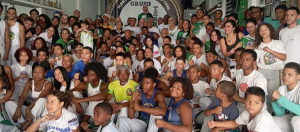
Déborah Ciarla: More than 300 children have been part of the project. During the pandemic, unfortunately, we had to suspend activities. After resuming, we currently have around 70 active participants. Training sessions take place three times a week, both in the community and on the beach.
Coluna da Neuza: What is the project’s relationship with the community like?
Déborah Ciarla: We are affiliated with the residents’ association, which helps us with the use of space and local communication. We also receive support from the local radio station, which promotes new groups and announces changes of location, if necessary.
Currently, our audience is exclusively children. Families do not yet take part in the project’s daily activities, but we are gradually trying to get closer to them, showing how we can contribute to the community as a whole.
Coluna da Neuza: Does the project carry out activities beyond rugby?
Déborah Ciarla: Not at the moment, but we are looking for partners to offer other activities in the future. Rugby still isn’t a popular sport, and many people keep their distance simply because they don’t know it. We do slow, grassroots work, gradually introducing this new possibility.
Coluna da Neuza: What have been the project’s greatest achievements so far?
Déborah Ciarla: At first, we thought the greatest achievement would be developing athletes who would reach the Brazilian national team, and that did happen. But today we understand that our greatest success is seeing these children remain in formal education, complete their studies, and realize that the world is much bigger than the community where they live.
They begin to see new possibilities for education, work, and future paths. This broadening of perspective among the project’s participants is our greatest achievement.
Coluna da Neuza: And what are the main challenges today?
Déborah Ciarla: Our biggest challenge is financial. The resources raised in previous years have already been fully used, and now, in 2026, our funds are close to zero. The big question is: when will we be able to fully resume activities?
Respect and discipline through sport
Physical education teacher Raissa Vieira, 27, spoke about her experience as a rugby coach in the project.
“Rugby é Nossa Paixão is a project where I worked as a coach, and it allowed me to get to know boys and girls from the Cantagalo community. Through rugby, they began to practice respect and discipline and learned how to live together while respecting each other’s differences. For me, this is a project that represents great potential, a powerful tool for social transformation, and being part of it was deeply meaningful.”
Appreciate the project? Learn how to help
To continue supporting its beneficiaries, diversify activities, and help more people get to know the sport, Rugby é Nossa Paixão needs you.
There are several ways you can help, for example, by sharing the project, making a donation via the PIX below, or volunteering in areas such as healthcare, first aid, psychology, and education.
PIX: rugbyenossapaixao@gmail.com
For more information, please contact: rugbyenossapaixao@gmail.com
Follow, like, comment on, and share the project’s profiles on Instagram and Facebook.