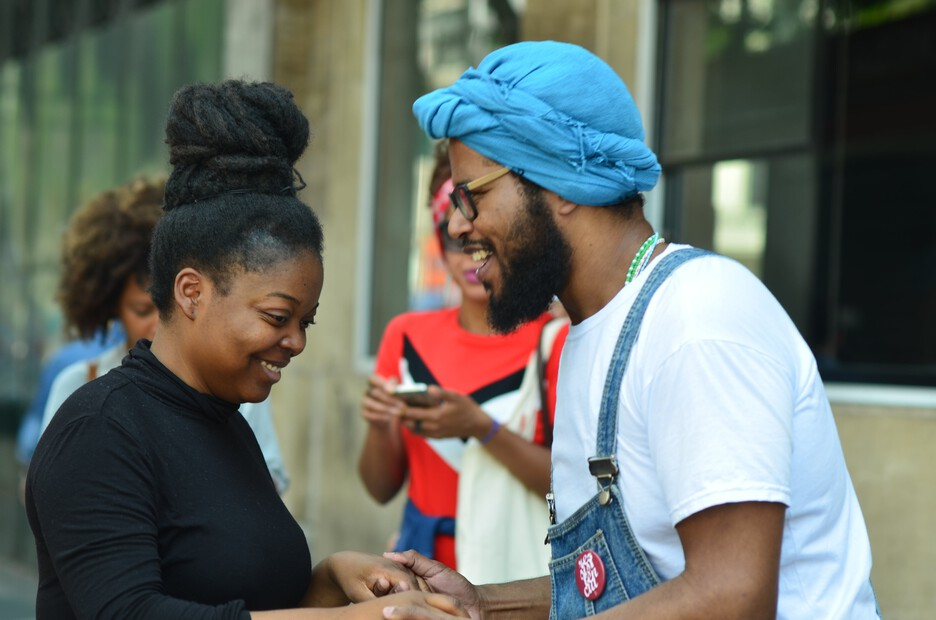
Agency innovates by producing independent content and travel itineraries focused on Black history and culture
Racial literacy, diversity and sustainability. Based on these three pillars, Guia Negro has been offering new ways to experience local tourism. Through authentic content and walking tours, it’s possible to discover the most vibrant aspects of Black history and culture in various Brazilian cities.
It all began with independent content production in 2017. In less than a year, the travel experiences took to the streets. The first walking tour was held in São Paulo’s Liberdade neighborhood. With tours lasting about three hours, public demand grew. From Liberdade, it expanded to Bexiga—also in São Paulo—then to Salvador, followed by Olinda, Boipeba, and São Luís.
Today, it operates in most Brazilian capitals, including Brasília. Anyone who thinks this is a niche tourism segment is mistaken. Through campaigns, afrotourism has even been promoted by Embratur, Brazil’s official tourism agency. “How can I call it niche tourism when 56% of Brazil’s population is Black?” says journalist and founder Guilherme Soares Dias.
Passing through historical sites, facts, and memories of Black personalities, the visits alternate between past and present events. “When we designed the walking tour, we didn’t want it to be just about the past, which is often tied to pain and resistance. That’s why we also talk about the present — about Black culture, positive memories, and even tips on places to eat food with African heritage”, explains Guilherme.
Black history and culture
The itineraries also highlight the richness of Afro-Brazilian festivals and cultural traditions. In Olinda, for example, they explore the history of maracatu; in Macapá, marabaixo; in São Paulo, samba rock; in Salvador, blocos afros; in Rio, the samba schools; and in Minas Gerais, congada.
“In each state, we focus on something from the local culture — whether it’s capoeira, a terreiro (Afro-Brazilian temple), or something connected to Black culture that showcases a place tourists wouldn’t otherwise know. In São Paulo, for instance, during the Liberdade tour, we visit the Chapel of the Afflicted (Capela dos Aflitos). In Salvador, we visit the Society for the Protection of the Needy (Sociedade Protetora dos Desvalidos). Sadly, these sites are still not part of traditional tourism maps. That’s why the tours are so revealing”, says Guilherme.
The walking tours are organized in groups of up to 35 people, led by local hosts. On average, around 3,000 people take part in Guia Negro tours each year. The itineraries have been so well received that schools and companies now seek them out to promote racial literacy among students and employees.
The audience is diverse—ranging from judges and teachers to people experiencing homelessness supported by social centers. “We really value when parents and children join together because the conversation continues at home and in school,” the founder adds.
“Those who take the tour with us usually have an awakening — they start wanting to understand more about Black culture in the places they visit, the things traditional tourism overlooks.”
A growing movement
Guilherme came up with the idea for the tours after returning from a trip. “I had just done a backpacking trip and visited many places tied to European history and culture. But I saw very little about Black history because there was almost no content or agencies offering such tours. Realizing this gap, my partner Heitor and I started creating content to spark interest in these destinations and to offer such travel experiences ourselves”, says the founder.
“While backpacking, I realized we weren’t learning these stories on our trips. When I came back to São Paulo, I noticed there were many walking tours—on architecture, Avenida Paulista, even haunted histories — but none about Black history. So we created the tour São Paulo Negra”, he continues.
“When we started in São Paulo, our first itinerary was in Liberdade, a neighborhood known for its Japanese heritage. But it was originally a Black neighborhood. It had a whipping post, a space where enslaved people were beaten and killed, and even a cemetery exclusively for them. Nobody talked about that”, recalls Guilherme.
He remembers a tense episode in the early years. In 2020, during the São Paulo Negra tour, police followed the group for three hours, mistaking it for a protest. “That day, while we were discussing structural racism, we experienced it firsthand. It was striking”.
The case was taken to court, and the Brazilian state was ordered to pay R$720,000 to a collective afrotourism fund. Guia Negro won the case on appeal, with the amount adjusted to R$350,000. The state appealed again, but the ruling in their favor remains.
Political advocacy and local entrepreneurship
The agency also engages in political advocacy, challenging tributes to slaveholders and pushing for greater Black representation in monuments, street names, and public spaces. In Salvador, the group succeeded in renaming Rua Laranjeiras, originally honoring a slave trader, to Rua Alaíde do Feijão, in memory of the cook Dona Laíde.
They were also behind changing Praça Visconde de Cairu to Praça Maria Felipa, honoring a Black revolutionary from Brazil’s independence. In São Paulo, their work led to the removal of Japanese-style lamps from Rua dos Aflitos in Liberdade, a site of historical memory for the Black population.
Guia Negro’s tours cost between R$60 and R$80 per person, with private tour options available. The money spent by visitors circulates beyond the company itself. “Whenever we arrive in a place, we try to strengthen Black and local entrepreneurs. We buy from them and take our tourists there too,” explains Guilherme.
The impact is immediate. Guilherme cites a shop in Pelourinho as an example: “The owner told me that in May, which is low season, he was only able to pay the rent because we brought people there. That shows how our work helps sustain small businesses.”
Unlike common industry practices, the team doesn’t charge commissions from partner shops or restaurants. “We believe in and support them. That’s the difference,” he adds.
Afrotourism
Afrotourism has already caught the attention of major companies, such as CVC. “It’s like what happened with curly hair. Ten years ago, it was a marginal market — now it’s one of the most popular and profitable. The same is happening with tourism”, compares Guilherme.
The data is revealing: in 2023, Pequena África in Rio de Janeiro received more visitors than both Christ the Redeemer and Sugarloaf Mountain combined. For Guilherme, this growth is the result of a collective movement: “I combined two passions — journalism and tourism — and created my own opportunity. Today, we inspire other companies and professionals. It’s transformative to see that this has real impact”.
With eight years of experience, the tours have been reclaiming stories erased by formal education and official narratives. “Every day, we discover new characters and events we never learned about in school. Telling these stories is our way of recovering lost time and showing that tourism can also be a tool for historical reparation”, he concludes.
Want to learn more?
Visit the Guia Negro website, support independent content production and follow their pages on Instagram and LinkedIn.