Initiative in Rio de Janeiro invests in training as a pathway to strengthen trans employment and address historic inequalities
The reality of the trans population in Brazil is challenging. Research by the Associação Nacional de Travestis e Transexuais (Antra) indicated that, in 2024, 122 deaths were recorded, which keeps the country as one of the most lethal for this community.
Despite a 16% reduction compared to 2023, Brazil, for the 16th consecutive year, remains the country that kills the most trans people in the world, with the life expectancy of this population being only 35 years.
In addition to violence, the trans population still faces many stigmas and prejudices in society, which intensify when seeking employment, a scenario that highlights the challenges of trans employability in the country. According to a 2025 survey by the Instituto de Pesquisa Econômica Aplicada (Ipea), only 25% of trans people were formally employed that year, a rate 6.8% lower than that of the general population.
It was by observing this inequality that, in 2019, Andréa Brazil founded Capacitrans. “Every beginning has some foundation based on pain. I, as a travesti, realized that the great difficulty is having formal employment”, she said.
“The idea of creating something that would provide autonomy for the LGBT+ population came when I opened my first salon. There, unconsciously, I already had the concept of what Capacitrans would be. I wanted a team made up of trans people and LGBTs in general, with vulnerability profiles”.
A hairdresser and beauty instructor for more than 10 years, Andréa realized that she could enable this population to achieve autonomy and “not depend on an exclusionary and prejudiced market”. From that vision, she began to structure the project also as a path to strengthen trans employability.
With this concept in practice, she took an entrepreneurship course. “There I learned what it truly meant to undertake. It was not just having that survival impulse. It is building a business to make a living”.
“Then, combined with the business I already had, I transformed that learning into a business plan for a social project”.
Next, Andréa sought financial support through public calls and was selected by LGBT+ Orgulho, from Itaú Unibanco. “We had the opportunity to qualify 40 LGBT people, primarily trans people and travestis, within an intersectionality and exclusion framework”.
She explains that the project prioritizes trans people who are Black, from peripheral areas, low-income, in situations of social vulnerability and unemployed, but LGBTs in general are also accepted.
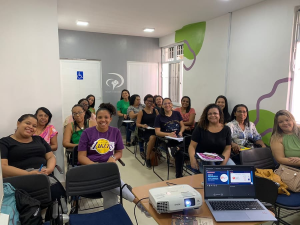
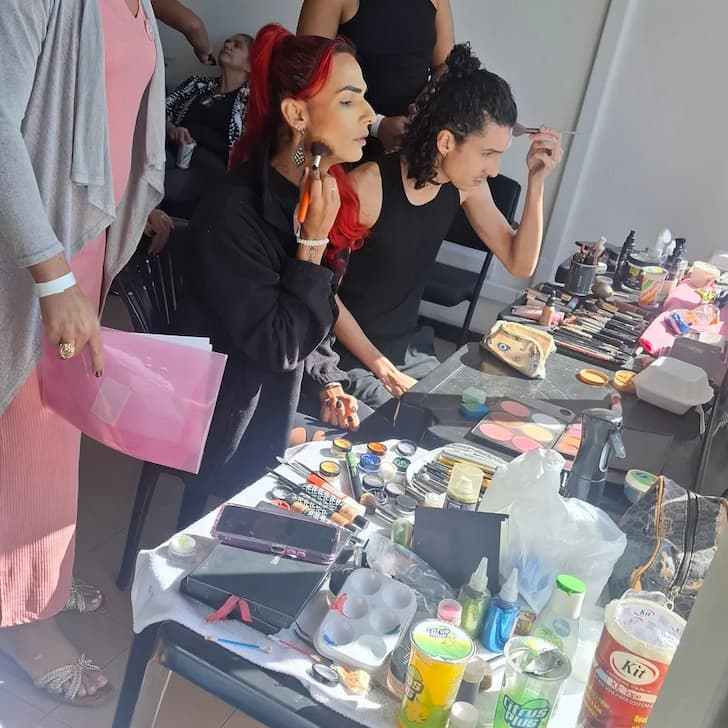
The institution began by offering courses focused on image care, such as hairstyling, makeup, sewing and tailoring and, more recently, audiovisual. The training programs are designed so that the person can undertake, independently or not, even starting with few or no resources.
“I used to think: how am I going to make this idea happen if I have no resources? So, I tried to share my experience of how I started from scratch, without an inheritance or direct financial backing”.
“Those who invested in me were people who believed in the idea and helped us grow with Capacitrans”, she adds. She explains that one of the first supporters of the project was the Igreja Anglicana São Lucas, through Father Luiz Coelho.
The audiovisual courses are more recent and have high demand. “The audiovisual classes are always the most competitive. We offer 20 spots, but in the first edition, we had 120 applicants”.
All classes take place in person, in the neighborhood of Senador Vasconcelos, in Rio de Janeiro. Andréa estimates that the project has already trained more than 500 people over these seven years.
After the training, most students start working with braids, hairstyles and makeup. “There are also people who are in audiovisual, growing in the field and gaining visibility”.
According to Andréa, many choose to undertake. One of the students, in fact, has been standing out with her brand of tucking underwear for trans bodies, which are pieces developed with high compression, reinforced fabrics and specific tailoring for greater comfort and safety.

Struggle and recognition
“Every 34 hours / There is a murder of an LGBTQIAPN+ person / Placing Brazil as number 1 in this type of violent death / That is why bringing light to the story of Xica Manicongo is fundamental”.
This is how the samba-enredo “Quem Tem Medo de Xica Manicongo?”, by Paraíso do Tuiuti, begins, which, in 2025, brought to the Marquês de Sapucaí the story of the first documented trans woman in Brazil, an enslaved person of Congolese origin who lived in Salvador in the 16th century.
By bringing to the avenue the trajectory of resistance of trans people throughout history, the parade reinforced the importance of confronting structural inequalities that still impact areas such as safety, citizenship and trans employability.
Andréa was invited by the school to parade on the last float, titled “Traviarcas”, a tribute to travestis and trans women over 45 years old, pioneers and activists in the country.
“At the technical rehearsal, I had to pass through all the wings to reach our float, and in all of them there were people who had gone through Capacitrans shouting: ‘godmother, godmother’. That scared me, because I realized the dimension of the project, how many people had been impacted by us”.
The recognition was also repeated in other spaces. Andréa enrolled in a characterization makeup course offered by Ação da Cidadania and shared the opportunity with her network. When starting the classes, she had another surprise: “All the groups formed had someone from Capacitrans”. Some were already working as hired professionals.
Trans employability
The project also operates as a talent bank for companies seeking referrals of professionals and wishing to make their teams more diverse and inclusive.
In this way, the institution maintains a partnership with the City Hall of Rio de Janeiro, through the Executive Coordination of Sexual Diversity. Between 2024 and 2025, it was also a partner of Sesc: the institution provided the space, and Capacitrans carried out the training of the LGBT+ community.
Restoring citizenship
“We have civil rights classes in an accessible way, because there are several levels of schooling. There are people who only completed elementary school. We need to use language that reaches everyone, from those with lower schooling to those with incomplete higher education”.
She explains that the classes go beyond technical training. “There is no point in talking about undertaking and not talking about physical and mental health. Sometimes, there are people in the group who have never taken an HIV test or do not know the importance of treatment to become undetectable and have more quality of life”.
“Each class is not just a profession. It is also the restoration of citizenship. We talk about harm reduction, abusive use of alcohol and other drugs. When we talk about entrepreneurship, we do not romanticize it. We explain what it really is. A person who works as a ride-hailing driver, for example, is not necessarily an entrepreneur”.
For Andréa, confronting stigmas also involves understanding structural violence. “Society sees us as if we were on the streets because we want to be. It is not like that. Many times we are expelled from home while still minors. I heard: ‘my son will not wear women’s clothes’. And, when you are thrown out, someone may either take you in or groom you,” she concludes.
Did you like it? Check how to help!
Follow Capacitrans on Instagram to keep up with news and new course groups.