From the 1st Rio Refugia Forum to the state’s largest multicultural festival, the initiative held at SESC Tijuca brought together experts, organizations, entrepreneurs and artists to discuss challenges, strengthen support networks and celebrate the diversity of migrants and refugees
Throughout June, SESC Tijuca, one of the cultural and community centres operated by the Social Service of Commerce (SESC), was transformed by Rio Refugia 2026 into a space for dialogue, inclusion and the celebration of diversity. The programme was part of the activities marking World Refugee Day, observed annually on June 20. The series of events began with the 1st Rio Refugia Forum on June 17 and culminated in the eighth edition of the multicultural festival, held on June 20 and 21.
The initiative brought together representatives from civil society, institutions and refugees who now work as artists, entrepreneurs, teachers and community leaders, highlighting the leadership of people who have transformed the experience of displacement into an opportunity to rebuild their lives and actively contribute to society.
More than a sequence of events, the initiative sought to build a bridge between reflection and action. While the forum created a space for discussions on reception policies, inclusion and strengthening refugee participation, the festival showcased the results of these efforts through the gastronomy, music, dance, handicrafts and entrepreneurial initiatives of people who have rebuilt their lives in Brazil.
Lupa do Bem’s Coluna da Neuza, a Sherlock Communications initiative, covered both events and witnessed how stories of resilience, belonging and hope shaped the programme.
Dialogue and leadership at the 1st Rio Refugia Forum
The 1st Rio Refugia Forum opened with a performance by the Comay Candela collective, made up of Latin American women who use dance as a means of cultural expression, identity building and celebrating their ancestral heritage.
The performance was followed by the panel discussion “Civil Society Organizations and Refuge in Rio de Janeiro: Perspectives Based on the Experiences of Refugees”, which brought together four refugees who rebuilt their lives in Brazil: Venezuelan Maria Gabriela Moreno, Congolese Rama Tutshumu, Venezuelan Gustavo Martínez and Moroccan Mohammed El Jazouli. The discussion was moderated by Priscila Pereira, Social Projects Analyst at SESC Tijuca.
Drawing on their personal experiences, the speakers shared the challenges of leaving their home countries, rebuilding their lives in a new country and language, and turning the refugee experience into opportunities for employment, entrepreneurship and meaningful contributions to Brazilian society.
The central message of the discussion was a call for refugees to no longer be viewed solely as beneficiaries of social programmes, but to be recognised as leaders capable of creating businesses, generating knowledge, strengthening communities and contributing to the economic, social and cultural development of the state of Rio de Janeiro.
Stories of new beginnings and integration
This perspective was echoed by 28-year-old Venezuelan Armando Marchena, who lives in Rio de Janeiro’s North Zone.
“Rio Refugia is incredibly rewarding because it reflects who we truly are. Here, I am recognised for my work, my culture and my determination to start over. The event makes it clear that refugees have a great deal to offer and that our culture is incredibly rich. It also makes me feel welcomed and respected. For me, Rio Refugia represents hope, dignity and the certainty that it is possible to start again.”
Another topic widely discussed throughout the forum was the role of culture, education, art and gastronomy as powerful tools for bringing people together, reducing prejudice and fostering genuine integration between Brazilians and migrants.
The morning concluded with a special coffee break entitled “Refuge in the Kitchen” and a mini fair featuring partner organizations, extending the conversations initiated during the forum and providing participants, organizations and visitors with an opportunity to exchange experiences and strengthen connections.
Multicultural festival celebrates diversity and entrepreneurship
Just a few days later, these connections came to life during the 8th edition of Rio Refugia 2026, considered the largest multicultural festival dedicated to refugees and migration in the state of Rio de Janeiro.
Also organised by SESC RJ in partnership with Abraço Cultural; PARES Cáritas RJ, a humanitarian organisation that supports refugees, asylum seekers and vulnerable migrants; Feira Chega Junto, an initiative that promotes refugee and migrant entrepreneurship through multicultural markets; and the United Nations High Commissioner for Refugees (UNHCR), the event celebrated World Refugee Day by welcoming thousands of visitors to a free and diverse programme.
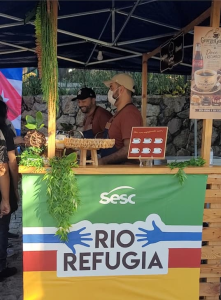
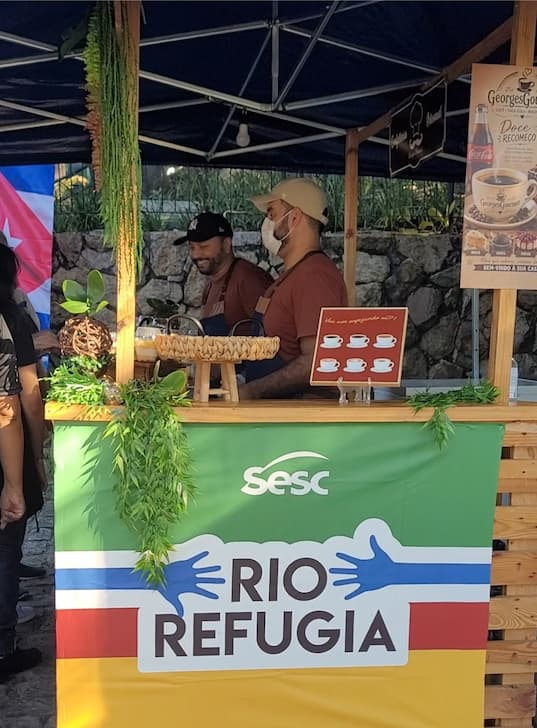
One of the festival’s main attractions was the multicultural marketplace, where entrepreneurs from different nationalities presented traditional dishes, sweets, clothing, accessories, handmade crafts and other products that carried not only the identity of their countries of origin but also stories of courage, resilience and hope.
The refugee entrepreneurs leading the exhibition and sales, representing Colombia, Angola, Venezuela, the Democratic Republic of the Congo, Syria, Nigeria, Iran, Cuba and Lebanon, demonstrated how entrepreneurship has become an important pathway to financial independence and economic inclusion for those forced to rebuild their lives far from home.
In addition to the marketplace, family-friendly activities, live music performances, traditional dances and experiences for all ages, including Afro braiding, turban workshops and other cultural activities, transformed the venue into a true meeting point for cultures, bringing together Brazilians, migrants and refugees through art, music and social integration.
It was precisely this shared experience that captured the essence of Rio Refugia 2026. Beyond discovering new flavours and enjoying cultural performances, visitors had the opportunity to engage with exhibitors, hear their personal stories and understand that behind every product on display lies a journey marked by challenges, courage, resilience and hope.
For 35-year-old Venezuelan David González, who also lives in Rio de Janeiro’s North Zone, this is one of the event’s greatest strengths.
“Rio Refugia is extremely important because it shows that refugees have so much to contribute with. Here, my culture, my work and my experience are valued. The event makes me feel welcomed and part of society, while bringing refugees and Brazilians closer together. In my view, together we can build a more diverse, welcoming and opportunity-filled city.”
More than a festival: a commitment to inclusion
The importance of the initiative is further underscored by Brazil’s current migration landscape. According to data from UNHCR, Brazil’s Ministry of Justice and Public Security, and the International Migration Observatory (OBMigra), Brazil is currently home to more than two million migrants.
Of these, more than 165,000 refugees have been officially recognised by the Brazilian government, while tens of thousands of asylum applications are still awaiting review.
This reality reinforces the importance of initiatives that promote reception, integration, income generation and the fight against xenophobia.
Rio Refugia has established itself as a permanent platform for dialogue among public institutions, civil society organizations, companies and citizens committed to building a more inclusive and diverse society.
By combining discussions, entrepreneurship, culture and community engagement, the initiative demonstrates that cultural diversity is a powerful force capable of transforming communities, expanding opportunities and strengthening social inclusion.
At the conclusion of both the 1st Rio Refugia Forum and the 8th edition of Rio Refugia 2026, one message stood out clearly: the true significance of the initiative extends far beyond its cultural programme.
The project demonstrates that, when dialogue overcomes prejudice and empathy replaces indifference, a more humane society emerges. One in which refugees are no longer defined solely by the hardships they have endured, but are recognised for everything they are capable of building and contributing.
Follow Lupa do Bem on Instagram, Facebook e LinkedIn.
Coluna da Neuza is part of Lupa do Bem, the Corporate Social Responsibility initiative of the communications agency Sherlock Communications.