Renaissance NGO offers cutting and sewing courses, with sustainable fashion as its main pillar
Founded in 1914 in the city of São Paulo, the Renaissance NGO aims to provide opportunities and develop skills for underprivileged communities. Through this mission, the family-run project has been impacting the lives of residents in 18 communities across São Paulo.
The organization offers computer skills and workplace exercise courses, donates food baskets, and carries out activities at Vila dos Idosos, a residential complex dedicated to senior citizens in the Pari neighborhood. However, the project’s flagship initiative is fashion.
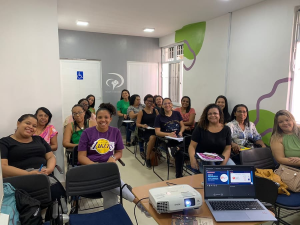
Based at the Circuito de Compras Shopping Mall, in the Brás district, the NGO offers classes in cutting, sewing, and pattern making. “Participants begin with a general theoretical foundation, learning about sustainability and its importance. Then we move on to customization and patchwork (a sewing technique that consists of joining pieces of fabric to create a larger piece). We give students a lot of freedom to exercise their creativity,” explains Luciana Leite, the NGO’s coordinator.
Courses last an average of three months and serve around 30 students. New classes are announced on Instagram, but according to Luciana, word of mouth is even more effective. Participants must be at least 18 years old.
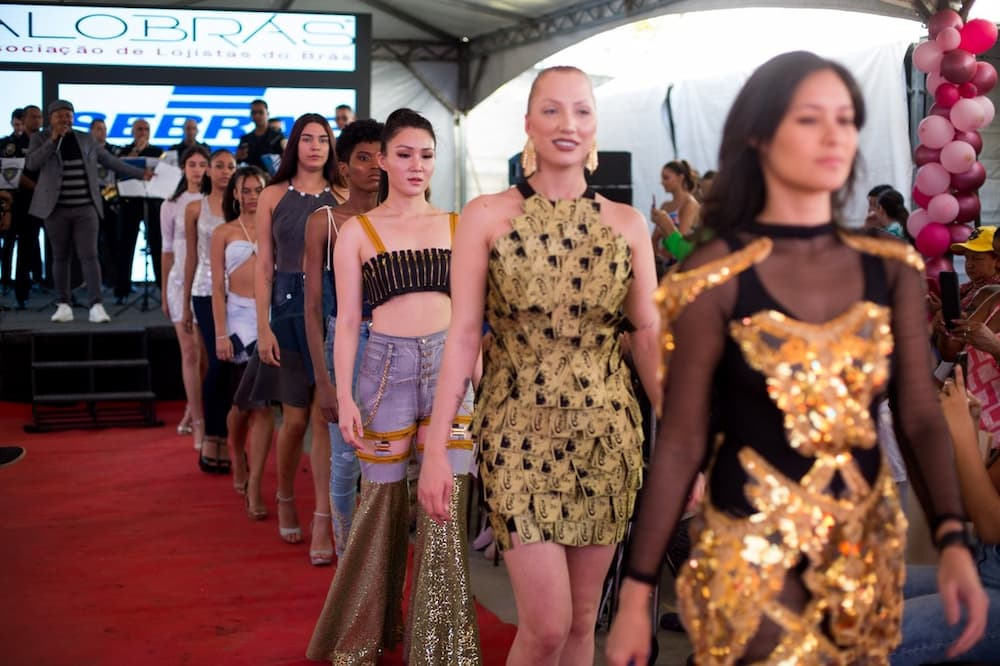
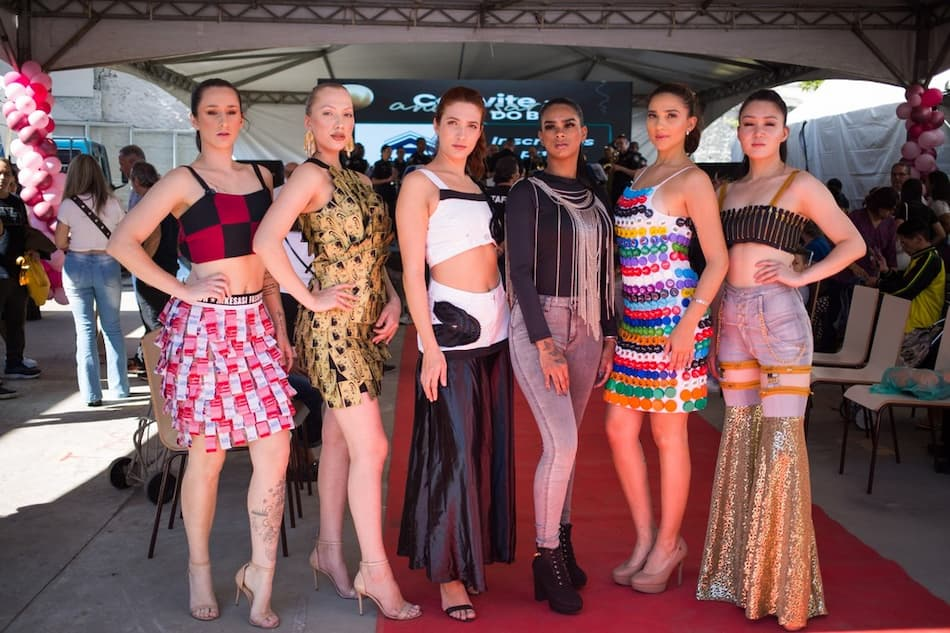
At the end of each course, a fashion show is held. “Students are informed at the beginning of the program so they can start understanding how to organize a fashion show from start to finish. It’s very rewarding for them to see how it all works”, Luciana says.
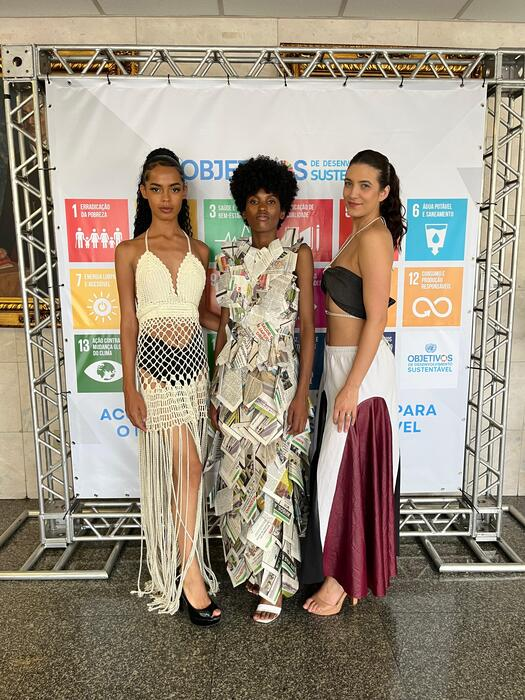
In November 2024, the NGO was invited by UNESCO to take part in the opening fashion show of the National Conference on the Sustainable Development Goals (SDGs), held at the São Paulo City Council. On that occasion, one of the showcased pieces was presented as a gift to Mia Mamede, Miss Brazil 2022, who serves as an SDG spokesperson for the United Nations and as an ambassador for the SDG Institute, and who delivered a speech at the event.
Sustainable fashion and income generation
A study by the Ellen MacArthur Foundation reveals that the fashion industry has already released more than 1.2 billion tons of toxic gases into the atmosphere. In addition, a garment is worn 36% fewer times before being discarded compared to the early 2000s.
On the other hand, a survey conducted by fintech company Koin indicates that around 87% of Brazilians prefer to buy clothing from brands that adopt sustainable practices. Among the main factors influencing this choice are the type of fabric (31.1%), the origin of materials (18.6%), the production process (12.4%), support for environmental causes (11.2%), and recycling and reverse logistics practices (4.3%).
Aware of this market trend and of the sector’s impact on the planet, the NGO began offering courses focused on sustainable fashion. “We are raising awareness about the importance of circular consumption, reusing garments and transforming them into beautiful new products. We also seek to show that these people can develop new professions within circular fashion”, Luciana explains.
She emphasizes that virtually any material can be transformed into clothing, including PET bottle caps and newspapers, which can be turned into striking garments. “It’s exciting to see students thinking outside the box, because we provide the foundation and they become increasingly engaged and creative”, she says.
According to Luciana, many participants eventually leave informal jobs to work under formal employment contracts, while others go on to start their own businesses.
With sustainability still at its core, the NGO, in partnership with UNESCO, has created a Recycling Plant. However, the initiative is not yet operational, as it is awaiting approval from the city government for a suitable space.
“I believe this project will greatly benefit Brás, because unfortunately, at the end of the day, there is a large amount of discarded fabrics and textile scraps, and when it rains, everything gets clogged. The Recycling Plant would help remove this waste, reuse it, and also generate employment”, Luciana concludes.
How to help
Renaissance NGO welcomes volunteers and donations. To learn more, visit the organization’s website or get in touch via Instagram.