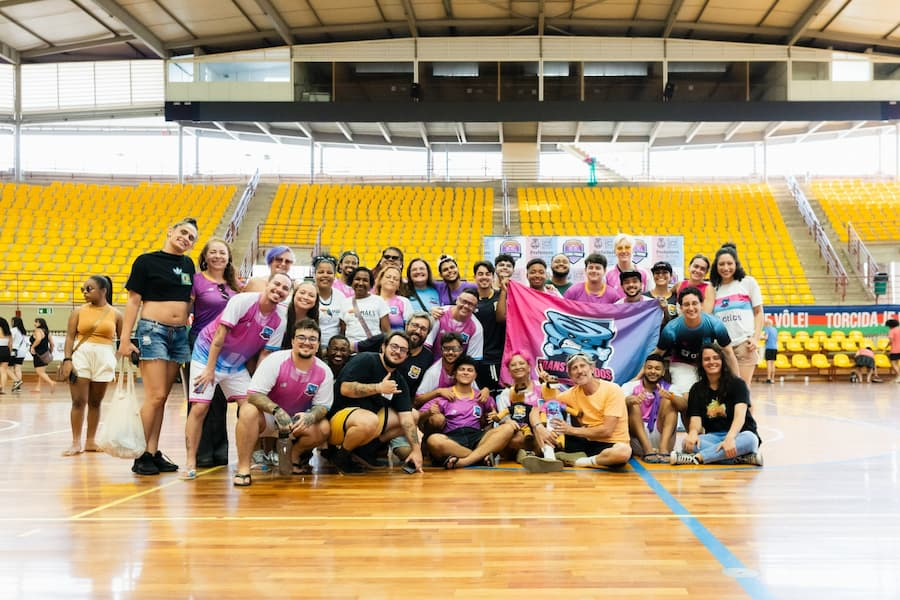
Created from informal soccer matches, the collective brings together trans, transvestite and non-binary people around sport, collective care, and the occupation of public spaces in Juiz de Fora (MG), strengthening soccer for trans people in the city
Some stories begin simply: a ball, a court, and the desire to play. That’s how the Transtornados collective was born in Juiz de Fora (MG). What started as a group of casual pickup games among trans people eventually grew into something much bigger: a space for connection, collective care, and community building.
In this Minas Gerais city, LGBTQIA+ mobilization already has a well-established history, marked by the work of collectives, cultural events, and rights advocacy initiatives. Juiz de Fora is home to longstanding organizations within the movement, as well as events such as Rainbow Fest and the Pride Parade, which over the years have brought thousands of people into the streets.
To better understand Transtornados, I spoke with Gabriel Del’Duca, a 28-year-old trans man, software engineer, and president of the collective. The conversation revealed not only the story of a sports group, but also of a support network that grows stronger week after week.
Soccer for trans people and the challenges in public spaces
“The Transtornados started as a group of pickup games just for trans people. From that coming together, we began to realize the need to be in places that felt safer for us,” Gabriel said.
In the beginning, the meetups took place on the court at São Mateus Square. But the experience quickly revealed the limits that many trans people still face when occupying public spaces.
“Our first games were there, but we started to face some violence from people who were around or passing by,” Gabriel recalls. “That made the need to organize even stronger.”
The solution came through the search for other spaces. The group began using private courts to keep playing. But another obstacle arose: money. Not everyone could contribute financially.
That’s when a partnership with the Secretaria de Esporte e Lazer de Juiz de Fora (Juiz de Fora Department of Sports and Leisure) emerged, which provided a multi-sport court for the group’s gatherings. From then on, the collective began to take shape. It was also at that moment that the name was created.
“I came up with the name as a joke. There’s this idea that trans people are ‘troubled’ (‘transtornadas’). So we turned that into something of our own.”
Reclaiming the term became part of their identity. But Transtornados has never been just about soccer.
At their weekly meetups, the group also takes part in other sports and traditional games. Dodgeball, volleyball, handball, and even small improvised races are all part of the program.
The goal is simple: to get the body moving and create moments of connection. “All of our activities are meant to bring us together, to play and have fun. There’s no intention of becoming professional. It’s a moment for relaxation and unity,” he says.
For those who take part, this space ends up becoming much more than a sports activity. Karoline, a 26-year-old trans woman, says she joined the group expecting just a moment of leisure.
“At first, I thought it was just a team to play soccer and unwind, but in practice I realized it’s a united family, with one purpose: to be happy.”
According to her, that happiness can take many forms. “Sometimes it’s playing futsal; other times it’s dodgeball or capture the flag. Transtornados is much more than a team; to me, it’s a family.”
On and off the court: support networks in trans-inclusive soccer
Over time, the initiative also began to connect with other organizations in the city, including support groups and entities focused on defending LGBTQIA+ rights. These connections helped expand the reach of the group’s actions.
“As our meetups became more established, we kept growing more and more as a collective,” Gabriel says.
Today, the group maintains dialogue with different organizations and takes part in institutional spaces for debate on public policies. Gabriel also serves as secretary of the Conselho Municipal dos Direitos das Pessoas LGBTs (Municipal Council for LGBTQ+ Rights). For him, building this support network is one of the group’s greatest achievements. “We’ve created a strong and solid network. We’re always supporting each other.”
The impact of this sense of community is clearly reflected in the testimonies of those who take part. Jupiter, a 24-year-old non-binary person, shares that “at first, Transtornados was an opportunity to get back into sports and take care of my body, but it ended up becoming something much bigger. Over time, I realized it goes far beyond that. The collective showed me the power of living in community.”
Being around other trans people also had a direct impact on their process of self-discovery. “I came into contact with different lived experiences, and that helped me build my identity.”
According to Jupiter, the group’s support also had concrete effects on their life. “With everyone’s support, I was able to access rights that once felt out of reach, such as legally changing my name and undergoing a mastectomy.”
Among the most significant milestones in the group’s history, Gabriel highlights the beginning of activities in February 2023, and about a year later, when the group began to officially recognize itself as a collective. “In January 2024, we felt that we were truly established.”
Another important milestone was the Copa PJF de Futebol Trans (Trans Soccer Cup of PJF), organized with support from a parliamentary amendment by former city councilor Thalia Sobral. The event brought trans people together around sport and represented a symbolic moment of occupying public space. “The first Cup was a huge achievement for us,” Gabriel recalls.
Despite these accomplishments, there are still significant challenges, such as financial ones. “For a collective to exist, it needs funding. Even with the court provided by the city, we still have to cover maintenance costs.”
Currently, the group relies on a few occasional donors, but resources are still very limited. Even so, despite the difficulty in securing sponsorship, the collective continues to grow.
“Transtornados is a collective that allows me to exist”
For many participants, what keeps the group alive is the sense of belonging it provides. Pedro Braga, a 26-year-old trans man, says that before discovering Transtornados, he believed the trans experience was a solitary one, but that perception changed when he found the collective.
“There are so many different people, all together, playing soccer and interacting. It seems simple, but it’s very special. For me, Transtornados is a collective that allows me to exist.”
Beyond sports activities, the group also takes part in organizing the city’s annual Trans March. The initiative began through the mobilization of another local collective and now has the support of several organizations.
“Astra was the one that kickstarted it and managed to get the march onto the city’s official calendar, and Transtornados helps with the organization,” Gabriel explains. This collaboration shows how the group has become an active part of the local trans movement. “The first Cup was a huge achievement for us. It was beautiful to see so many trans people gathered, happy, practicing sports, and occupying a public space.”
For him, initiatives like this carry even more weight in politically sensitive moments. “In 2026, which is an election year, we know we’ll face a lot of attacks, and doing this again makes it even more meaningful.”
Appreciate the initiative? Learn how to join and support it
Gabriel invites anyone interested in learning more about the project. “This is an open invitation to everyone who supports our cause, come and help strengthen our collective and any other trans collective across Brazil.”
Transtornados’ meetups take place every Sunday, from 2 pm to 4 pm, at the court of the Secretaria de Esporte e Lazer de Juiz de Fora (Juiz de Fora Department of Sports and Leisure). The initiative, which promotes soccer for trans people, has established itself as a space for inclusion and community.
Address: Rua Custódio Tristão, No. 11, Santa Terezinha, Juiz de Fora, Minas Gerais.
The choice of day is no coincidence. On Sundays, public transportation in the city is free, making it easier for those who might otherwise struggle to afford the fare to attend.
If you liked the project and want to help, the collective is also looking for volunteers willing to contribute in different areas. Support in communication, outreach, IT, or website development are some of the ways to get involved. Ideas and contacts are also very welcome.
For more information, follow Transtornados on Instagram.
The Neuza Column is part of Lupa do Bem, a Corporate Social Responsibility project by the communications agency Sherlock Communications.